





Market report
Understand painters’ practical priorities
Explore the Painter Insight Monitor for research on professional painters’ product choices, price sensitivity and sustainability expectations. Use the hub to put environmental propositions in the context of the performance, reliability and buying habits that matter to this trade.
Blogs I published 06 February 2025 I Dirk Hoogenboom
The Green Shift in Painting - Sustainability and Practicality
The Green Shift in Painting – Sustainability and Practicality
Research context: the Painter Insight Monitor 2024 and commentary published in February 2025, with a separately dated 2021 segmentation. Product attributes, buying criteria and willingness to pay are different measures.
Sustainability is one of the hottest topics across many industries, so it’s no surprise that European painters are joining the conversation. But while the push for green alternatives is growing, the question is – what’s their take on this shift? It turns out that while we do see an interest in sustainability, practicalities still rule the decision-making process, meaning the transition to greener alternatives becomes a bit more complex than just offering eco-friendly options.
So what do painters really think about sustainable products and what will it take for eco-conscious solutions to become the norm? Let’s look at the specifics.
What Painters Mean by Sustainability: the 2024 Research
Sustainability is an industry-wide word, but it means different things for different sectors. So when it comes to painting, what are the professionals saying? According to the Painter Insight Monitor 2024 – a yearly report on dominant trends across the sector – full-on sustainability doesn’t always top the list.
As far as top criteria for buying sustainable products go – durability (38%), quality and ease of use (19%) or pricing (16%) – we’re noticing that they’re more closely linked to functional performance than actual environmental impact. More specific and detailed markers (like water-based products, a low carbon footprint, recyclable materials or a transparent supply chain) were only mentioned by a small share of painters, clearly underscoring traditional preferences in the industry. While environmental friendliness was noted, it was a secondary concern for only 15% of respondents, meaning: painters are still looking for reliable, high-quality products that get the job done well before considering how eco-friendly they are.
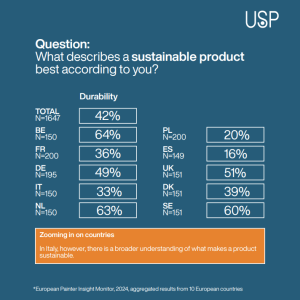
The 42% lifespan figure describes what makes a product sustainable; the 38% durability figure describes a buying criterion. They answer different questions.
Familiar Choices Are King
Long story short, most painters aren’t looking to experiment: specialized wholesalers remain their go-to and traditional buying habits still hold strong. Painters generally tend to rely on products they’ve used before and trust, and this pattern extends across everything from paint and consumables to power tools. Reliability is key, and while sustainability is becoming a topic of interest, it’s not yet the top priority when making a purchase. What is?
Durability First
If there’s one thing that trumps all others when choosing a product, it’s durability. A whopping 38% of painters rank durability as their number-one priority when buying sustainable products. When it comes to power tools, that number jumps to 49%. Why? Because long-lasting products make the job easier, save money over time and reduce downtime due to replacements or failures.
Painters operate under tight deadlines and budgets, so they need tools and materials that won’t let them down. This is where sustainability often faces a challenge; if an eco-friendly product doesn’t handle the day-to-day mileage well, it won’t win over professionals in the industry.
Quality Over Flash
Right behind durability, quality and ease of use are the second most important factor, with 19% of painters prioritizing it. For paint specifically, that number rises to 23%. A product needs to perform well, and that could mean smooth application, strong adhesion or a tool that withstands the usual wear-and-tear. Painters don’t really want products that claim to be sustainable; they need them to deliver top-tier performance first and foremost.
In many cases, flashy marketing won’t have any impact. If an eco-friendly paint doesn’t go on as smoothly or doesn’t provide the same coverage as a traditional one, it’s unlikely to become part of a painter’s toolkit.
Price
Quite simply put, a green transition comes with a hefty price tag. And painters are well aware of affordability, with some 16% of them listing price as a key consideration. They’re willing to invest in high-quality and durable products, but cost will remain a guiding factor. This poses another hurdle for eco-friendly alternatives – if sustainable options are significantly more expensive than traditional products, adoption will be slow.
Sustainable vs. Built-to-Last
When it comes to choosing so-called “sustainable” products, we see that painters tend to zero-in more on performance and practicality, rather than on environmental impact. More pronounced sustainability factors – a low carbon footprint, recyclable materials or supply chain transparency – barely register in their decision-making. This reinforces the industry’s preference for tried-and-true products over those marketed primarily for their eco-friendliness.
The Role of Manufacturers
Most painters agree that manufacturers play a vital role in making the transition to sustainable products easier. The majority believe that manufacturers should:
- provide more information about sustainable products to painters (64%) and end-users (66%)
- offer take-back programs for old products (63%)
- replace current assortments with more sustainable options (62%)
Painters aren’t necessarily against sustainability, they just need the right support, information and incentives to make the switch. Manufacturers that can bridge the gap between performance, affordability and eco-consciousness will have the best chance of winning over even the toughest industry pros.

Sustainability Trends Across Europe
Some 42% of painters listed a long lifespan as the most important attribute of a sustainable product, and this trend is particularly strong in Belgium (64%), the Netherlands (63%) and Sweden (60%). However, when it comes to actual environmental features like water-based formulas, solvent-free solutions, or biodegradable materials, the numbers are telling: only 13% of painters prioritize eco-friendliness.
Water-based products (6%), solvent-free ones (6%), biodegradable ones (5%) or recyclability (5%) – in other words, staples of environmentally friendly approaches – all rank significantly lower.
Sweden (14%) and Denmark (16%) show a higher interest in eco-friendly options, but Italy stands out with a greater focus on sustainability, its painters clearly showing a preference for biodegradable products (24%), emphasizing eco-friendliness (21%) and 16% opting for solvent-free solutions. However, for most of Europe – Netherlands, Poland, Spain… – sustainability translates to longevity rather than other environmental attributes.
Willingness to Pay
While cost remains a tangible barrier in the transition process, some European painters are willing to invest in sustainable products for their projects. In fact, nearly 20% are ready to pay an additional 6-10%, 11% would go as high as 16-20% more, and 14% are even open to spending over 20% more compared to standard products. This means that awareness, a growing concern and commitment to sustainability is out there somewhere, despite the higher expenses.
It’s worth mentioning that a notable 23% remain unwilling to pay more, highlighting that any shift towards an eco-friendly position will first need to address cost concerns.
The 2021 Painter Types: Familiar Habits Can Coexist with Sustainability
The 2021 Painter Insight Monitor described four painter types across ten European countries. This is a historical framework for understanding attitudes, not a claim about the size of these groups today.
The result is four segments: Innovative painters, conscious painters, hassle-free painters and conservative painters. Roughly, these range from the most innovative to the more conservative. However, since there are more characteristics involved, two groups who have their own distinct identities emerged in between the innovator and conservative extremes. The profiles below describe those characteristics.
On the one side, the innovative painter constantly working on a better future for himself, his business, his clients and the world entire. He loves innovative solutions and novelties that help him increase efficiency, optimise his business, inform and manage his clients, or cut time wasted on administrative tasks.
On the other side we find the conservative painter who basically likes to do business as he has always done it, with a team of regular employees, for a strong network of regular clients. He shows no interest in innovations, except for a minor interest in solutions for more efficiency or easier administration.
Then there is the hassle-free painter who is happy with the way he works, including the balance of painting and administrative tasks, and does not want to be hassled with novelties to change that. He is even less interested to change and innovate his way of working than the conservative painter.
Lastly, we have the conscious painter, who just wants to paint, really, and does not like other tasks. That means he is open to ways to improve efficiency, especially when it reduces time wasted on administrative tasks, but at the same time, the conscious painter does not really want to innovate the way he works.
What About Sustainability?
That the innovative painter is into sustainable solutions to improve the impact paints and products have on himself and the environment, and that the conservative painter is not fussed about such things should come as no surprise. But what about the other two types, the conscious painter and the hassle-free painter, who are as uninterested innovating their way of working as the conservative painter?
It turns out they do care about sustainability, especially the conscious painter. In fact it is what makes the conscious painter conscious. He likes paints with fewer solvents and preservatives, and not just because of the risk of becoming an unconscious painter. Aside from an above-average emphasis on his own personal health, the conscious painter actually cares about the health of the environment as well. And even the hassle-free painter, who is in some ways more conservative than the conservative painter, cares about the impact paints and paint products have on the environment and personal health.
The distribution of these segments differed between countries. To find out more details about the characteristics of these painter segments and which painter types are dominant in 10 European countries, we refer you to USP Marketing Consultancy’s 2021 Painter Insight Monitor.
What’s Next?
Sustainability is gaining traction, but the painting industry remains hesitant to fully embracing eco-friendly solutions. Painters are generally open to the idea, but they won’t compromise on durability, quality or affordability. To drive meaningful change and motivate a change, manufacturers must offer sustainable products that perform just as well – if not better – than their traditional counterparts.
Providing clear, transparent information about sustainability, introducing take-back programs and making green products more cost-competitive will be crucial in shifting the industry’s mindset. Until then, painters will continue prioritizing what works best for the job at hand, regardless of how eco-friendly it may be.
For now, the demand for sustainable solutions exists, but the products must meet industry expectations before they become the standard. It’s not just about being green—it’s about being great.
Tailored market research A greener proposition still has to perform on the job. USP can help you understand how painters judge durability, quality and price, then test which benefits make your sustainable offer worth considering. Assess how durability, finish quality, price and environmental attributes influence painters’ product choices, so you can prioritise the benefits that matter most. Explore willingness to pay for sustainable paint or tools and identify how professional buyers judge premiums against expected performance and lifespan. Test sustainable product concepts with painters to understand application needs, perceived trade-offs and the support required before they consider switching products.Make sustainable products work for painters
Driver Analysis Research
Pricing Research
Product Development Research

Read more

12 December 2024 I Dirk Hoogenboom
Private: Sustainability and Painting – What Matters Most?

21 January 2026 I Dirk Hoogenboom
Painter Ergonomics: What the 2025 Exoskeleton Interest Data Shows

12 September 2025 I Dirk Hoogenboom
The Cost vs. Sustainability Gap in European Construction

14 January 2025 I Dirk Hoogenboom