




Market report
Investigate painters’ interest in innovation
Explore the 2025 Efficiency and Innovation report from the European Painter Monitor. Use its research on professional painters and innovation as context for investigating demand for ergonomic tools, then test practical requirements and adoption barriers for your own proposition.
Blogs I published 21 January 2026 I Dirk Hoogenboom
Painter Ergonomics: What the 2025 Exoskeleton Interest Data Shows
The 2025 Painter Insight Monitor chart measures interest in exoskeletons and wearable support devices. It does not measure adoption, injury prevention or proven productivity gains. The results below use the original chart categories.
Painters have always had strong backs and steady hands. That’s the nature of the job. But even the toughest of shoulders have their limits. After decades of rolling, sanding and cutting in ceilings, fatigue builds up like layers of paint. That’s why when the new generation of painters starts talking about “tech,” they don’t mean apps or marketing tools, but rather – something far more practical. They’re talking about physical help. Real, mechanical help. And that’s where exoskeletons come into the conversation.
Interest in Wearable Support
The Monitor shows that exoskeleton interest is both demographic and geographic.
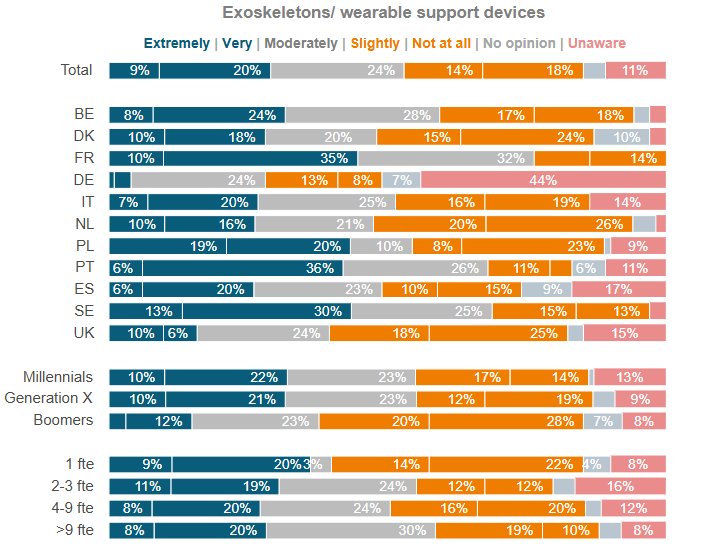
Across the total sample, 9% were extremely interested and 20% very interested: 29% combined. France showed 10% extremely and 35% very interested, or 45% combined. These figures describe the two strongest interest categories; they do not include moderate or slight interest.
For Millennials, the chart shows 10% extremely and 22% very interested, or 32% combined. For Generation X, the corresponding figures are 10% and 21%, or 31%. Interest levels should not be read as the share already using or planning to purchase a device.
The Painter Population Is a Different Measure
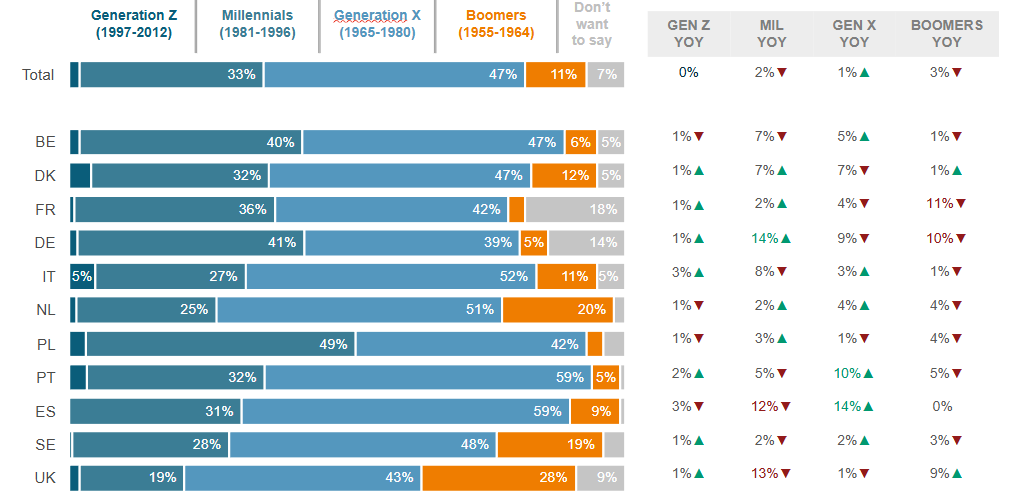
The total population chart shows 33% Millennials, 47% Generation X and 11% Boomers. Those population shares answer a different question from the interest percentages above. Country composition also differs, which is another reason to avoid assuming that one generation represents all painters.
What an Exoskeleton Is Designed to Do
Before the sci-fi imagery runs amok – they may sound like a robotic suit, but aren’t really. Passive models do not use motors or hydraulics. Think of them like a backpack rig or belt of springs, because passive models use springs, tension bands or elastic supports to offset the force needed to keep your arms overhead. In practical terms, an exoskeleton is a mechanical support frame that fits over the painter’s body – most often the upper body and arms – and is designed to redistribute physical load.
The intended support needs to be assessed for the particular task and product. An interest survey cannot establish how much physical load a device reduces, whether it improves finish quality or whether it is suitable for a particular painter.
Barriers to Trying a New Tool
Innovation always comes with friction. For exoskeletons, it consists of a mix of cost, culture and context.
Cost, comfort and usability are practical questions to examine before adoption. A purchase or rental proposition needs to fit the painter’s work, and the equipment needs to be evaluated in the tasks for which it is intended.
Fit, Use and Training
The original discussion also identifies a training gap: a misfit harness or wrong tension settings can increase fatigue. Proper use therefore requires product-specific fitting and instruction, rather than assuming that no training is needed.
What Manufacturers Can Learn from the Findings
Interest is a starting point for product research. It can help identify painters to involve in concept tests, but it does not establish purchase intent, willingness to pay or the size of a sales opportunity.
The key questions are practical: which tasks create a need for support, how a device fits the existing workflow, what makes it comfortable to use and what purchase or rental arrangement would be acceptable.
For Vocational Educators and Trainers
- Integrate ergonomics and wearable tech into curricula
- Teach the “why,” not just the how, behind body mechanics
- Make it part of professional identity – smart, safe, modern
Conclusion
Exoskeletons aren’t a magic fix – they won’t solve the labor shortage or change the impact of weather on jobs at hand, but they are a topic for further evaluation in a trade that rarely gets technological breakthroughs. They may help bridge a gap between traditional craftsmanship and 21st-century ergonomics and show that innovation doesn’t always mean digital transitions – sometimes it’s mechanical, resilience-centered, human. In a trade where endurance is everything, that’s a solid pitch.
Tailored market research
Test the market for ergonomic painting tools
Interest in wearable support is a starting point for research. Understand which painters see value, what could prevent use and how product design and price affect acceptance in real working contexts.
Product Development Research
Gather painter feedback on proposed ergonomic equipment to understand comfort, usability and task fit before making product decisions or claims about acceptance.
Pricing Research
Assess willingness to pay and responses to purchase or rental propositions, considering the budgets and usage patterns of different painting businesses.
Market Segmentation Research
Identify painter groups with distinct physical task demands, working contexts and innovation attitudes to focus concept testing and market development priorities.

Read more

03 October 2025 I Dirk Hoogenboom
Small Players, Big Impact – Understanding Europe’s Painter-Dominated Market Landscape

10 November 2025 I Dirk Hoogenboom
Sanding Robots for Painters: Hype or Real Jobsite Gains?

03 June 2024 I Dirk Hoogenboom
Why is Product Development Research Important and How To Do It?

04 November 2022 I Dirk Hoogenboom