



Market report
Compare electrical routes to market
Explore Purchase Channels Q3 2025 for research on electrical installers’ channel choices, spending and ordering methods. Understand how wholesalers, direct manufacturer supply and online alternatives fit the purchasing behaviour of the markets your business serves.
Blogs I published 15 March 2024 I Maja Markovic
Who is the biggest challenger of the European electrical installation wholesale?
Who Is the Biggest Challenger of the European Electrical Installation Wholesale?
In the purchase-channel research discussed in our March 2024 overview of the European electrical installation monitor, we focused on the purchase behaviour of European electrical installers in seven countries.
Wholesalers and direct supply
One of the key findings is that their purchase behaviour remains very traditional and the specialised installation wholesale remains very dominant. Looking at the share of wallet of the installers, approximately 70% is spent via the specialized wholesalers.
The biggest challenger in terms of share of wallet is direct supply via the manufacturers. In that overview, this represents 10% of the total share of wallet of European electrical installers.
In some countries, like Germany, this is even higher at 14%. Even though their purchase behaviour remains very traditional, there are some clear developments in the market that could favor direct supply from manufacturers in the future.
Online ordering through established suppliers
One of these developments is online ordering. This has increased significantly in all countries. For example, in the Netherlands, 70% of all orders at the specialised wholesale are placed online. This online ordering behaviour might be a double edged sword for the specialised wholesale. On the one hand, it shows that the wholesale has adopted e-commerce well and are not in danger of being outperformed by pure online players like Amazon when it comes to online ordering. On the other hand it might weaken the strong ties with the installers, as the face-to-face contact at the stores will be reduced.
Direct supply from manufacturers might benefit from this, as the weakened ties might make it easier for the installers to start placing more orders online at the manufacturer in the future. Furthermore, they are already used to ordering products online, so that is no longer a strong barrier.
In the same overview, 47% of all orders placed at manufacturers of electrical equipment are placed online.
The potential, however, is significantly higher when it comes to online ordering directly from the manufacturers.
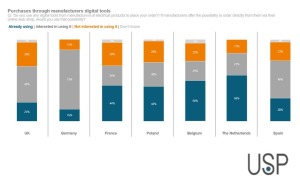
We asked the European electrical installers if they use any digital tools from manufacturers of electrical products to place their orders and if not, if they would be interested to do so.
On a European level, 34% of all electrical installers use digital tools from manufacturers of electrical products to place their orders. This is the highest in the Netherlands with 56%.
However, 41% of the European electrical installers would be interested in using an online direct ordering option from manufacturers. Only 22% would not be interested in this option at all.
The highest interest can be found amongst German installers, with 73% finding this option interesting.
So there is still a big potential for more direct supply via manufacturers, especially via online ordering tools and software. This might even start to challenge the dominant position of the electrical wholesale in Europe in the future.
Pure online stores: use is different from share of wallet
Online ordering from a wholesaler or manufacturer is different from buying from a pure online retailer. The Q4 2023 European Electrical Installation Monitor examined the latter separately.
In our Q4 2023 report of the European electrical installation monitor on purchase channels, we report that 30% of electrical installers in Europe utilize pure online stores, albeit predominantly for small-scale purchases. Notably, installers in the UK and Poland lead in the proportion of share of wallet allocated to pure online shops, though the overall share remains relatively low at 8% and 9% of their total purchases, respectively. Product category plays a significant role in online purchasing behaviour, with power tools emerging as the most frequently bought items through online channels.
Amazon emerged as the dominant player in the pure online landscape in that report, with its business platform being the preferred choice for most installers across various European markets when they used a pure online channel.
How established suppliers were already moving online in 2021
The Q4 2021 European Electrical Installation Monitor asked 825 electrical installers in seven countries about their purchasing behaviour. Its findings show why a supplier’s share of wallet and the way an order is placed need to be distinguished. These are historical results from a separate wave.
The digitalisation trend clearly manifests itself in the way installers order. Looking at the traditional specialised wholesalers, the purchase channel at which European installers spend the lion’s share of their budget, a quarter of installers’ purchases are already ordered online through wholesalers’ web shops or apps. The other three quarters of installers’ purchases are ordered traditionally, either instore or at a distance through phone, email or sales reps.
On the other side of the spectrum, Dutch installers seem to embrace online ordering the most, as a whopping three quarters of their purchases from specialised wholesalers are ordered online. They are followed by Belgium, where about half of installers’ purchases are ordered through specialised wholesalers’ web shops or apps. In these two countries, ordering online has clearly become the norm.
Knowing how installers order is essential for manufacturers and brands whose installation products are sold through this channel, as the success of their sales and marketing strategies may depend on it. Facilitating sales through web shops, for instance by supplying the right product details, descriptions and imagery to easily give your products a good appearance on a web shop, may have a positive effect on sales in areas where online ordering is common.
At the same time, manufacturers should be aware of the power of a good web shop for installers to order products directly from those manufacturers. In the 2021 research, about a tenth of European installers’ budget was spent purchasing directly from manufacturers. Almost a third of those direct purchases were ordered online through their web shops or apps.
Why online price checks do not automatically lead to switching
The European Electrical Installation Monitor Q4 2020 examined pricing agreements and channel loyalty. Almost all installers had some kind of price agreement with wholesalers, most often fixed discounts.
Due to the rise of e-commerce, installers can also check prices online and order via online shops to get the best prices and thereby increase their margins. Based on that research, at least 50% of installers checked online prices. Be that as it may, those who checked prices online used this information to negotiate with wholesalers rather than buy online for a better price.
Manufacturers should be aware that price agreements do not automatically build loyalty. According to the installers, the annual bonus agreements do not impact their brand decision. The only exception is France, where half of the electrical installers argue that annual bonus agreements strongly influence their brand decision.
These historical findings help explain why digital ordering and price comparison can grow without immediately displacing established supplier relationships. They do not establish current discount levels or a universal price difference that will make an installer switch.
Tailored market research
Assess the real potential of direct ordering
Interest in a digital ordering option does not reveal how much business would move. USP can help investigate installer journeys, assess a defined channel opportunity and test what makes your offer valuable against existing supplier relationships.
Customer Journey Research
Map how electrical installers choose ordering channels and move between wholesaler and manufacturer touchpoints, identifying the needs a direct ordering offer must address.
Market Size Research
Estimate the value of a defined direct-supply opportunity by product category and country, distinguishing stated installer interest from the spending it could represent.
Driver Analysis Research
Assess the importance of availability, pricing, delivery and ordering convenience in installer channel choice to identify priorities for evaluating a direct-sales proposition.

Read more

05 February 2024 I Dirk Hoogenboom
Private: Electrical installers only spend a small share of wallet at pure online players
04 March 2021 I Dirk Hoogenboom
Private: Pure online players can disrupt installers’ traditional buying journey

22 July 2025 I Dirk Hoogenboom
The New Rules for Reaching Electrical Installers in 2025
06 April 2023