

Market report
Understand how painters find information
Explore the Painter Insight Monitor for research on professional painters’ behaviour, brand preferences and changing market needs. The hub brings together studies that can help you place digital communication alongside the purchase channels and practical priorities of your painter audience.
Blogs I published 20 June 2022 I Dirk Hoogenboom
Digital media are becoming more important to reach European painters
This guide brings together the 2021 and 2022 Painter Insight Monitor findings and an interview published on 18 January 2023. These are dated research findings, not a measurement of painters’ media habits in 2026 or 2027.
Painters can be quite traditional, for instance in the ways and channels through which they acquire information and inspiration. Be that as it may, the population of painters is constantly evolving and developing, not only due to market trends like sustainability or labour shortages, but also due to the progress of time itself. While the oldest of painters are leaving the market for a well-earned retirement, younger generations of painters slowly but steadily take over their positions.
Due to these generational shifts, the media orientation behaviour of the average painter may change. That may have implications for the effectiveness of current and future marketing strategies of manufacturers and brands of paint and paint-related products. That is why USP Marketing Consultancy constantly monitors the developments of painters in 11 European markets, and why we made media orientation the theme topic of the 2022 Painter Insight Monitor.
Traditional and Digital Channels in the 2022 Research
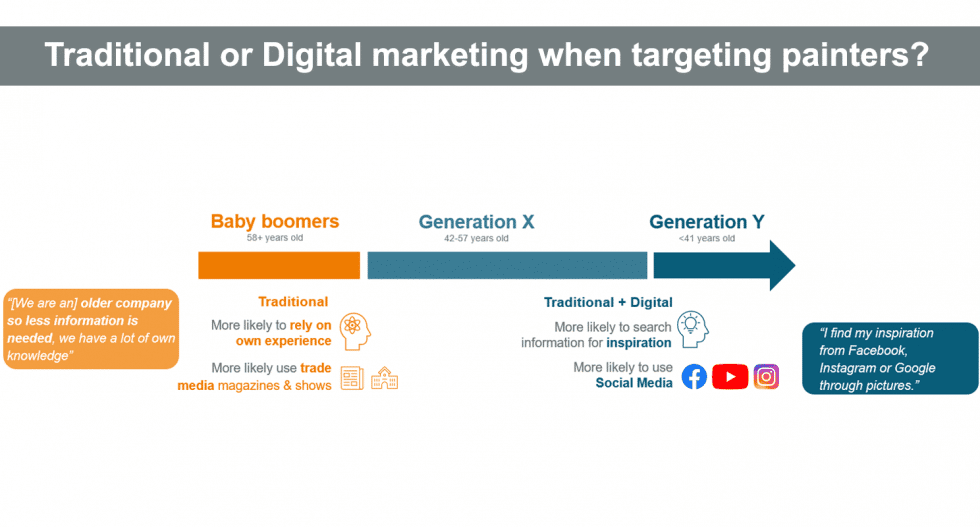
Traditional Media Were Still Dominant
Whether it is to find information on products and applications or to find inspiration, the media channel European painters use the most are websites. However, traditional media sources like staff and information at the purchase point, sales representatives, colleagues and trade magazines are still dominant when taken together. Compared to that, digital sources like the internet and social media are used less. In that sense, the media orientation of the average European painter is indeed quite traditional.
However, as we have seen in the 2021 monitor on segmentation of European painters, it may not be wise to base a marketing strategy on the average painter, as there is great diversity among the European population. That is also the case for media orientation of painters. When looking at media channels used by different generations of painters, for instance, an impending shift in media orientation appears.
Younger Generations Used More Digital Media
As the above image illustrates, the oldest generation of painters predominantly use traditional sources and tend to rely more on their experience, not just to find necessary information but also for inspiration. Younger generations do not have as much experience to rely on, however, and make more use of both traditional and digital sources of information and especially for inspiration.
Of all digital sources available, younger generations of painters increasingly use social media or images found through search engines for inspiration for their paint jobs. In fact, generation Y finds social media like facebook, pinterest, youtube and Instagram more important than websites of wholesalers.
Social Media: Information and Inspiration Are Different
For our monitor market studies, we regularly research media orientation behaviour among all sorts of professionals involved in the construction and installation sectors. Media orientation is also the theme topic of the 2022 Painter Insight Monitor, for which we interviewed 2200 painters from 11 European countries. As it turns out painters are one of the most traditional of all professionals in the construction and installation sectors where it comes to their media behaviour.
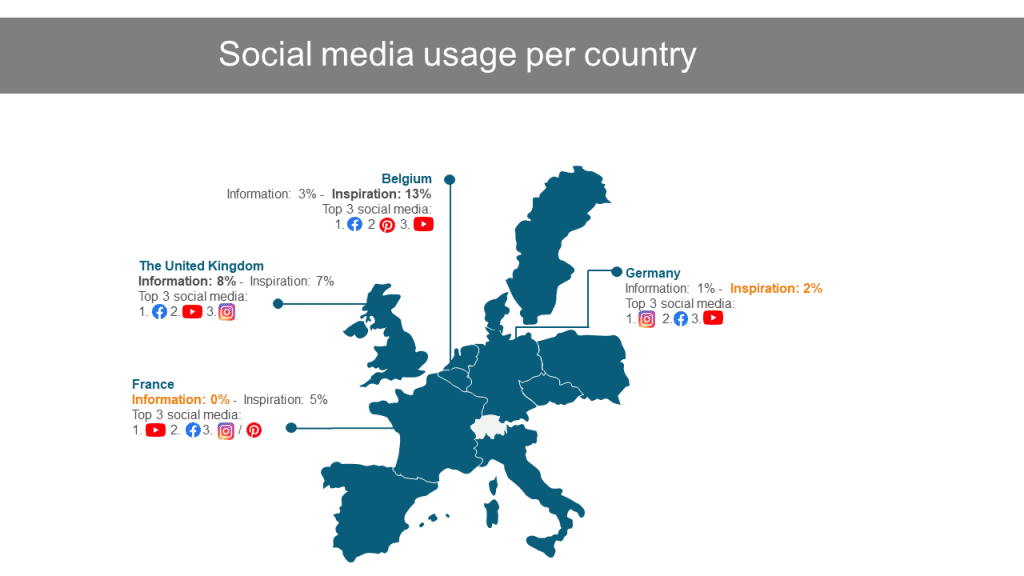
In ten of the eleven countries we measured, only between 0% and 4% of painters use social media professionally to gather information. The share of painters who use social media to get inspired is slightly higher, but still only ranging between 4% and 8% in ten of the eleven countries. On average it is safe to conclude that whether for information or inspiration, European painters barely use social media.
There are some exceptions though. Regarding using social media as a source of information, UK painters stand out as 8% of them report to do so. To get inspired, 13% of Belgian painters use social media, the highest percentage measured. The youngest generations of painters form an exception as well, as they are more likely to use social media, especially for inspiration. On average though, social media are a rather insignificant in the orientation behaviour of European painters.
Age and the Trade Counter Help Explain the Pattern
There are several explanations for painters’ lack of social media usage. First of all, and maybe most importantly, the average age of European painters in the 2022 research was about 50, which is one of the highest of all professionals in the construction and installation sector. That means the previously mentioned youngest generation of painters who are more likely to use social media is quite underrepresented. The older painter population helped explain why average usage was lower than usage among the youngest painters.
Additionally, if there is a need for information, the purchase point is very important. This is often the case among professionals in the B2B environment of the construction and installation sector, but especially so for painters, who are predominantly relying on traditional wholesale channels for both purchase of and information on products.
The Purchase Point: Zeynep Kutsal’s January 2023 Interview
In an interview published on 18 January 2023, Zeynep Kutsal, then consultant at USP Marketing Consultancy and manager of the Painter Insight Monitor, explained the relationship between online information and the trade counter. The figures and forecasts in the interview refer to that period.
When asking European painters their main sources of professional information, online sources are actually already at the top of the list. That is apparent in recent results of Painter Insight Monitor, a continual research among painters from 11 European countries. Does this mean that online channels are already the most effective channels to reach painters?
“Not at all,” says Zeynep Kutsal, consultant at USP Marketing Consultancy and manager of the Painter Insight Monitor. “Despite the rise of the online channel, the purchase point is still the most important source of product-related information among painters and will remain so for a long time.” We asked her to clarify this claim which seems rather bold in the face of the above-mentioned results.
“Painters Are Still Relatively Traditional in Their Media Usage”
First of all, the share of painters mentioning online sources as their primary source of information may be the largest of all channels, but it is still quite low compared to other professionals in the construction. “Looking at contractors or installers, for instance, we see that the shares mentioning online sources as main sources of information are much higher than the 30% of painters.”
“Of the top five main information sources mentioned by painters,” Zeynep continues, “only one is an online source. And here that represents all websites and search engines that painters use. Contractors and installers have many more online sources in their top five. So in that sense, painters are still relatively traditional in their media usage.”
“The Purchase Point Is a More Important Source of Information for Painters”
Number two and three of the top five main sources of information for painters relate to the point of purchase. The staff and available information material at the purchase point were named as the main sources of information by around 20% of the painters. As Zeynep explains: “when we take them together and look at purchase channels as a whole, the purchase point is a more important source of information for painters.”
So based on the current usage of information channels, manufacturers may want to focus on the purchase point, instead of dedicating more marketing budget to promote their brands online. But we know that online channels are used more by younger painters, who will take over from their older colleagues in due time. So how future-proof is investing in marketing through purchase points?
“Using Online Channels More Does Not Mean Using Offline Channels Less”
“The younger generation of painters more often use online sources than the older generation, that is true. But when we look at using the purchase point as a source of information, there is no difference between generations. So, using online channels more does not mean using offline channels less,” Zeynep answers.
It is clear that the point of purchase should not be underestimated as a channel to reach painters now or in the future. The most efficient way to use this channel will vary though. As Zeynep concludes: “The best means and materials for marketing through purchase points will depend on the type of product and on the type of purchase channel used to buy it.”
The 2021 Segmentation: Product Interest Does Not Determine the Channel
The fact that most painters are not keen to change the way they work does not necessarily mean that most painters are also unwilling to change the products they work with. The 2021 research showed that a majority of European painters are actually interested in novelties like healthier and more sustainable paint products, even though most of them are not interested in changing or innovating the way they work.
That means that a dualistic segmentation of painters is unrealistic, which is why we divided them into four segments in USP Consultancy’s 2021 Painter Insight Monitor: innovative painters, conscious painters, hassle-free painters and conservative painters. Each of these segments represents a substantial part of the European painter population, and in each segment, painters share certain mentalities and preferences.
Innovative and conscious painters care a lot about the environment and their personal health, and hassle-free painters also care quite a bit, whilst conservative painters do not seem to care much about that at all. Still, that means that painters in three of the four segments could be interested if you happen to offer more sustainable paint products. The question is how to reach those potential customers.
Why an Online Campaign Could Miss Interested Painters
Should you offer more sustainable and healthier products, three of the four segments of painters could be interested. If you mainly focus on online marketing to reach those painters, however, a lot of them may not notice you at all. The 2021 segmentation showed that the conscious painters, who care about the environment and health, were less online-minded. So if you follow a mainly online-based marketing strategy, chances are you will only reach a fraction of the potentially interested painters. Again, this shows that the European painter population is too complex for a simple dualistic segmentation.
To say it bluntly, the features of your product, no matter how innovative or sustainable they may be, are not enough on their own to determine what success that product can have in the market. What matters is that you know your painter, that you truly understand what the painter who you direct your product at wants. The above shows that there is no such thing as the painter and that detailed segmentation of painters is necessary to support the success of marketing and sales strategies.
In the Painter Insight Monitor, we offer precisely such a segmentation. This segmentation was based on research conducted among 2,250 painters from 10 European countries. For a detailed segmentation of not only the entire European painter population but also the differences per country, we refer you to USP Consultancy’s 2021 Painter Insight Monitor
What the 2022 Findings Meant for a Multichannel Approach
Despite a still increasing average age of European painters, the unstoppable force of time will make generation X and Y more predominant in years to come. Online presence is already a good item to include in a marketing strategy aimed at European painters, but the role of social media campaigns in the overall strategy should be assessed for the painter groups and information needs being targeted.
As younger generations of painters make more use of social media for inspiration and older generations use the more traditional channels for their information needs, the 2022 findings supported an omnichannel approach. However, just like there are differences between generations, there can be vast differences between media orientation behaviour of painters in different countries. For a full overview we refer you to USP Marketing Consultancy’s 2022 Painter Insight Monitor
Tailored market research
Build a media mix around real painter behaviour
A younger painter population can change how information is discovered without removing established habits. USP can help you understand your audience, map influential touchpoints and assess whether your brand is visible where painters look.
Market Segmentation Research
Identify painter groups with different information habits, experience levels and business needs so your communications reflect more than an average trade profile.
Customer Journey Research
Map how painters move from inspiration and product research to purchase, including websites, colleagues, sales representatives and the trade counter.
Branding Research
Measure awareness and perceptions of your paint brand among priority painter groups to understand where stronger recognition or clearer positioning is needed.