



Market report
Explore electrical smart-product adoption
Explore the European Electrical Installation Monitor for research on smart buildings, technology adoption and installer support needs. The hub provides an entry to studies that help manufacturers understand where connected-product propositions fit electrical installers’ working practices and local market priorities.
Blogs I published 02 December 2022 I Dirk Hoogenboom
Share of installers working remotely differs vastly between countries
Labour shortages are an ever-pressing issue in the world of construction and installation. That is also the case for electrical installers, who are in high demand and ever shorter supply in most European markets. One solution is to improve installers’ efficiency so they can do more installations in less time, for instance by developing plug-and-play systems that are quick and easy to install.
That might save time on the installation but does not reduce time spent on maintenance and solving problems and malfunctions in systems that are already installed. Luckily, an increasing number of products and systems are connected to the internet. Aside from allowing owners control at a distance, these connected smart products allow installers the opportunity to monitor performance, assess malfunctions and run diagnostics of systems at a distance.
This possibility can save installers enormous amounts of travel time, as they may be able to solve a problem at a distance. If not, it allows installers to come well prepared and faster and more efficient on-site visits. Manufacturers are increasingly developing connected installation products that also allow working at a distance and can potentially save installers much time, but how many installers are making use of this possibility?
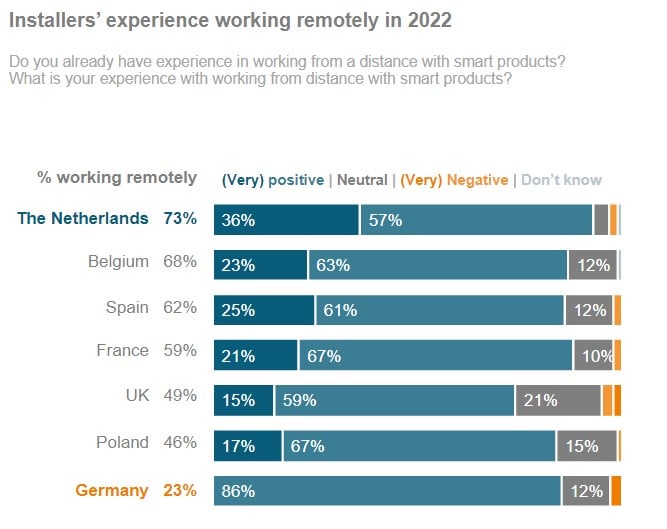
Installers work remotely the most in the Netherlands and the least in Germany
For the Q2 2022 report of USP Marketing Consultancy’s European Electrical Installation Monitor, which focuses on smart buildings, we asked electrical installers from seven major European markets whether they have experience with working at a distance with smart installation products. As it turns out, this varies widely per country. The largest share of installers that have experience working remotely is found in the Netherlands (73% of installers), which is not surprising. As we saw in a previous article, the Netherlands also has the highest share of installers involved in installing smart products.
The country with the lowest share of installers working remotely is Germany, where only 23% of installers claim to have such experience. This may have little to do with the number of smart products installed, and more with legislation. The most concrete explanation is that Germany has some of the strictest privacy legislations in Europe. That complicates the legal aspects of accessing a client’s system, thus preventing installers from working remotely.
Working remotely expected to continue to grow
Aside from legislation preventing installers to work remotely, they may also just be reluctant to change their way of working. Like many construction and installation professionals, electrical installers can be traditional in this, which can delay the growth of working remotely a little. Nevertheless, the time saving benefits of working remotely will win it from tradition if work pressure is high, which is what we already see in some countries.
Interestingly, installers who have experienced working remotely are positive about it. In all countries, most installers who worked remotely liked it, and only a tiny fraction considered the experience negative. By now this should not come as a surprise, but as a confirmation that working remotely indeed gets more jobs done faster in times of high work pressure due to labour shortages.
These shortages are expected to be a continuing problem. Meanwhile, the number of smart products installed is growing and the demand for smart systems will only increase due to other trends like sustainability for instance. Put together, both incentive and opportunity for installers to work remotely with smart products will only increase in time to come.
For manufacturers of smart installation products, it is essential to know in which markets these products are used the most and how usage is developing. For an overview of installers’ usage of and experience with smart building products and installations in seven European countries, we refer you to the Q2 2022 report of USP Marketing Consultancy’s European Electrical Installation Monitor.
Tailored market research
Understand what helps installers work remotely
Remote functions need to fit local expectations and everyday service tasks. USP can help you investigate installer experience, test connected-product propositions and identify audience differences before deciding how to position or develop your offer.
Product Development Research
Test remote-monitoring and diagnostic propositions with electrical installers to understand practical value, usability concerns and support expectations for different working environments.
Customer Satisfaction Research
Measure how electrical installers experience your connected products and support, identifying friction in setup, remote access and problem resolution that deserves attention.
Market Segmentation Research
Identify installer groups with different experience, project types and confidence in remote working to shape propositions around meaningful differences in customer needs.
Read more

31 July 2024 I Dirk Hoogenboom
How is the smart and connected products market evolving in Europe?
26 February 2026 I Dirk Hoogenboom
BIM and Digital Tools – Digital Maturity Without the Hype

15 June 2023 I Dirk Hoogenboom
Installers positive about remote working
21 March 2023 I Dirk Hoogenboom