




Market report
See how consumers choose where to buy
Explore consumer attitudes to online and physical stores in the Q2 2026 buying behaviour and decision journey report. Understand preferred purchase methods, reasons for choosing them and recognition of DIY retailers to support decisions about your route to market.
Blogs I published 13 December 2022 I Dirk Hoogenboom
Digitalisation has paid off for DIY stores, they are doing better than ever before
For years, the share of home improvement products that are purchased in DIY stores remained stable in Europe. During the pandemic, that share went down slightly due to restrictions for physical stores, while the share of online sales and thus the share of the pure online competitors of the DIY stores increased. Now that the pressure of pandemic restrictions has eased, however, the share of purchases at DIY stores has risen again.

The share of purchases at DIY stores is now at an all-time high of 49%. Despite the hit of the pandemic, the DIY stores have bounced back and are doing better than before. One explanation is that after their initial lag in e-commerce endeavours, DIY stores made a considerable leap over the past years in online presence and developing online shopping environments.
The fruits of those efforts are evident in the results of USP Marketing Consultancy’s Q2 2022 European Home Improvement Monitor, for which we asked over 6,600 consumers of home improvement products from 11 European countries about their purchasing behaviour.
Leroy Merlin is the best-known DIY web shop among European consumers
When asking consumers to name web shops where they can buy home improvement products online from the top of their minds, the websites of DIY stores seem to win it from the pure online players. In three of the four product categories, the number one top-of-mind webshop for home improvement products is the website of Leroy Merlin. Only for power tools, Amazon is named more often.
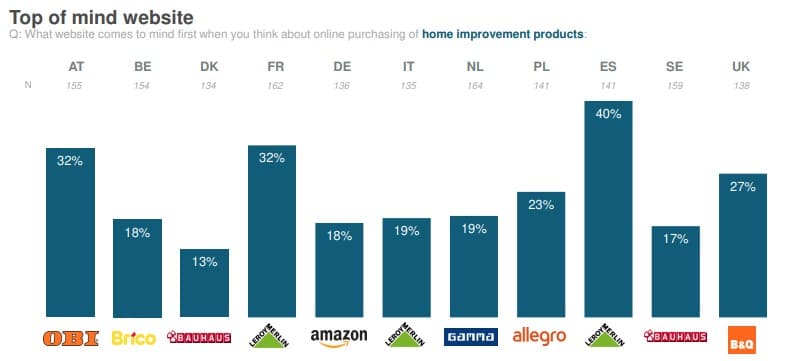
These are European averages of course, and the top of top-of-mind web shops will vary from country to country. Be that as it may, DIY store websites also win it from the pure online players when looking at most individual countries. Taking all product categories together, consumers in Germany and Poland first think of a pure online player more often, but in all other countries, DIY store websites are named the most.
DIY stores have caught up in the e-commerce race
Initially, DIY stores were running behind in e-commerce when pure online stores kicked off and started selling more and more home improvement products. But over the past years, DIY stores have invested in their e-commerce operations and the underlying platforms, making sure to provide a smooth online shopping experience for their clients. Those efforts are now paying off.
That is a significant shift compared to 5 or so years ago. The improvements in online operations of DIY stores are reflected by the mental availability of their websites among consumers. That mental availability means that if consumers purchase home improvement products online, chances are high that they will do so at the webshop of a DIY store.
Our expectation is that this will continue, as DIY stores are still improving their online operations. Consumers who are used to buying home improvement products at DIY stores will more likely choose those stores’ web shops when buying home improvement products online. Also, DIY stores offer knowledge and experience with the home improvement products they sell online as much as they do offline. As an extra benefit, products purchased online can often be picked up the same day if available in a nearby store.
For a full overview of the development of purchase channels in the home improvement market in 11 European countries, we refer you to the Q2 2022 report of USP Marketing Consultancy’s European Home Improvement Monitor.
Tailored market research
Connect your online presence with the shopping decision
Strong online awareness is useful when it supports the whole buying journey. USP can help you understand how consumers discover your offer, choose a retailer and experience the move between digital and physical shopping.
Customer Journey Research
Map consumers’ online research, store visits and purchase decisions to identify where information or channel handovers make shopping easier or harder.
Branding Research
Measure retailer and product-brand awareness across your target categories to understand which names consumers recall and associate with a useful offer.
Customer Satisfaction Research
Assess customers’ experience of your online and physical stores, comparing the touchpoints that influence satisfaction and identifying priorities for further improvement.

Read more

29 June 2022 I Dirk Hoogenboom
Optimising the online journey for brands of home improvement products more important than ever before

12 October 2021 I Dirk Hoogenboom
Consumers also find online orientation important for home improvement products bought offline

21 March 2023 I Dirk Hoogenboom
Consumers value shopping experience over product quality when rating DIY stores

13 May 2025 I Dirk Hoogenboom