


Market report
Track prefab in the contractor market
Explore the Contractor Monitor for research on prefabrication, digitalisation and the business pressures shaping construction. The available studies help suppliers assess adoption in its market context and consider how project types and contractor priorities affect the opportunity for prefab solutions.
Blogs I published 11 October 2024 I Dirk Hoogenboom
Rethinking European Construction: Prefab Trends
What does the future hold for prefabrication in the construction industry and how are European contractors adapting to the market shifts? These are focus points raised by our latest report, the European Contractor Monitor (Prefab H1-2024). This research – done twice a year and based on insights from larger contractors involved in significant commercial projects – goes into the key trends in the current landscape and potential future of prefabrication.
A Dip in Prefabrication
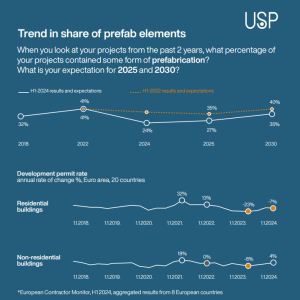
In 2022, prefabrication made up a healthy 41% of construction projects across residential and non-residential sectors. Fast forward to 2024, and that share has dropped to 24%. What’s driving this decline? Several factors:
New Build Pressure
Many European countries are experiencing a slowdown in new construction, and prefab is still very much a new construction game. So when new build accounted for 60-70% of the work, things looked promising. Now, the market is changing, and with renovation taking over, prefab is taking a proportional step back. And as long as it remains tied to new build, we will continue to see lower numbers.
Sustainability Needs
A growing emphasis on sustainability means existing buildings need retrofitting to meet modern standards. While this creates potential for prefabrication’s comeback, it hasn’t quite happened as of yet. As contractors continue to focus on green practices, we might again see prefab solutions gaining traction.
Geopolitical Challenges
The ongoing war in Ukraine and other geopolitical tensions have resulted in fewer construction projects. These instabilities create significant disruptions in the supply chain, in material costs, labor shortages, so companies reassess their project pipelines. The focus has shifted towards risk mitigation rather than expansion, stalling the adoption of advanced construction methods, including prefabrication.
Market Uncertainty
All this translates to – uncertainty. And when the market is in flux, contractors tend to stick to traditional projects and familiar methods. As companies grapple with the unknowns, the focus shifts towards minimizing risk and ensuring stability. Consequently, investment in new technologies and processes often takes a backseat, stifling progress and limiting the potential for growth in the sector. Despite these hurdles, there’s hope that as the market stabilizes and new builds begin to rise again, prefabrication will follow suit.
Architects Share the Same Story
Looking at architect stats, we are seeing a fairly similar trend, with a noticeable decline in prefabricated projects. After a peak in 2021, the numbers dropped in 2023 across various European countries. Some regions feel this shift more acutely than others, but overall, the industry is showing signs of resilience and adaptability.
Looking Ahead
So, what’s next for prefabrication in the construction industry? While the current statistics may seem concerning, they don’t capture the full picture. There is significant potential for growth in prefab, especially as sustainability takes center stage and the market begins to stabilize. With adaptability and innovation, we will soon see a renewed embrace of prefab in construction, leading to more efficient and sustainable building practices.
Want to learn more about the future of prefabrication? Download our latest report, “European Contractor Monitor (Prefab H1-2024),” for in-depth insights and analysis.
Tailored market research
Assess prefab opportunities against real project demand
Prefab demand depends on what gets built and how contractors work. USP can help you investigate local market conditions, estimate opportunities for defined applications and test solutions against the needs of target project teams.
Market Exploration Research
Investigate how new-build activity, renovation and competing construction methods shape the opportunity for prefab solutions in the markets you want to serve.
Market Size Research
Estimate demand for clearly defined prefab products and applications, separating addressable market potential from broad project-adoption percentages or general construction forecasts.
Product Development Research
Test prefab propositions with contractors and other intended users to understand installation needs, perceived risks and practical requirements before refining the offer.
Read more

17 April 2026 I Dirk Hoogenboom
Prefab in Europe: Growing to 30%, but Not Fast Enough

16 October 2024 I Henri Busker
The Building Blocks of Prefab: Key Materials

12 January 2024 I Dirk Hoogenboom
The Netherlands Leads Europe In Prefabrication Adoption

28 August 2024 I Dirk Hoogenboom