



Market report
Explore architects’ sustainability requirements
Explore the Q2 2025 architectural sustainability report for insight into adoption, drivers and barriers across European markets. Use the research to understand the context in which architects assess sustainable construction and identify questions to investigate about your product evidence and support.
Blogs I published 04 October 2022 I Dirk Hoogenboom
Proliferation of sustainability certifications causes confusion among architects
Whether through top-down pressure like the European Green Deal, or bottom-up demand from clients, the demand for sustainable buildings European architects encounter in their projects is ever growing. The construction process of buildings involves many different players, however, and as we have seen in our research among them, sustainability is a broad concept that can be understood in different ways.

Sustainability certification helps clarify the definition and allows measuring and quantifying the sustainability of a building to prove to government, clients and all other stakeholders in a building’s lifecycle how sustainable it actually is. Given the central role certification plays in sustainable construction and the central role architects play in the construction process, we asked architects from eight European countries which sustainability certification they consider most important in the construction industry.
Architects’ opinion on certifications varies a lot per country
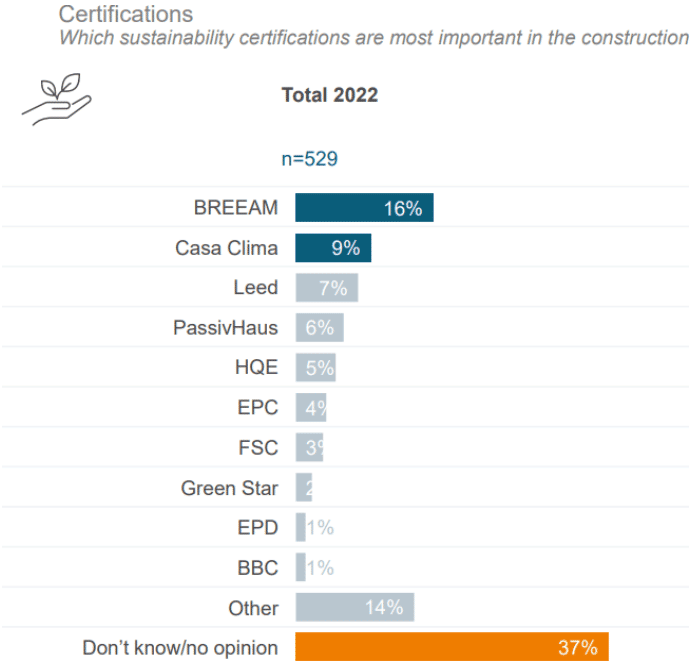
Of all types of certification, BREEAM was mentioned as most important by the largest share of architects. In a way that is not surprising, as it is the longest established building sustainability certification, originating in the UK in the 1990’s. Still, BREEAM is only mentioned as most important by as few as 16% of European architects. Those architects are mainly from a few of the researched countries, and clearly not from Germany or Italy, where BREEAM is not mentioned as most important certification at all.
The BREEAM example shows that the importance of sustainability certification for building construction is still very much determined by national boundaries. Casa Clima is an even stronger example of this. It is the second certification in the graph, mentioned as most important by 9% of European architects. Zooming in, our data revealed that those architects are only from Italy, where a whopping 71% of architects consider Casa Clima the most important sustainability certification.
Architects’ knowledge of sustainability certifications is limited
That in certain countries, certain certification is more predominant does not mean the above European averages tell us nothing solid. The most mentioned answer to the question which sustainability certifications are most important in the construction industry was ‘don’t know/no opinion’, mentioned by 37% of European architects. This shows that overall, architects’ knowledge of sustainability certification is still rather limited.
Looking at specific countries, the ‘Don’t know/no opinion’ shares range from 17% in France, to a whopping 70% in Germany. Italy is a great exception, though. As mentioned before, 71% of Italian architects considered Casa Clima the most important certification, followed by Leed (20%) and some others. Only 3% of Italian architects claimed to not know or have no opinion.
Manufacturers can become knowledge leaders
Aside from knowledgeable Italian architects, it is clear that the knowledge of European architects about sustainability certification is still limited, especially in certain countries. For manufacturers of building materials, this shows an opportunity to act as knowledge leader concerning sustainability certification, especially given that architects consider manufacturers’ websites the most important source of information on sustainability of materials.
To find out exactly which sustainability certifications are found most important in specific countries, and for a full overview of the view on and ideas about sustainability and circularity of architects from eight European countries, we refer you to the Q1 2022 report of USP Marketing Consultancy’s European Architectural Barometer.
Tailored market research
Make sustainability information relevant to specifiers
Certification awareness differs across markets, so the same message will not answer every architect’s question. USP can help you understand information needs, assess brand credibility and identify the criteria influencing sustainable product decisions.
Customer Journey Research
Map when architects seek sustainability evidence and which sources they trust, helping you identify missing information along the material-selection and specification process.
Branding Research
Measure whether architects perceive your brand’s sustainability communication as clear, relevant and credible compared with competing material suppliers in your target markets.
Driver Analysis Research
Assess the importance of certification, performance, cost and other selection criteria when architects compare sustainable materials, helping prioritise the evidence your offer needs.
Read more

22 September 2025 I Dirk Hoogenboom
Embodied Carbon: Europe’s Most Adopted Green Practice

20 June 2022 I Dirk Hoogenboom
Architects link circularity mainly to material aspects

14 July 2025 I Dirk Hoogenboom
Wired for Change – Sustainability and Electrical Installation

25 June 2025