



Market report
Understand architects’ views of circularity
Explore Sustainability Q2 2025 for research on architects’ adoption of sustainability and circularity, including barriers and stakeholder influence. Understand how professional perspectives shape the market before deciding how to communicate or develop a circular construction proposition.
Blogs I published 20 June 2022 I Dirk Hoogenboom
Architects link circularity mainly to material aspects
European architects are more aware of and involved in sustainable construction than in circular construction, as we saw in a previous article. Still, 75% of architects from the eight countries involved in the quarterly European Architectural Barometer are aware of circular construction and 29% claim their company is actively involved in it. But what do they actually mean when talking about circular construction?
That is one of the questions answered in the Q1 2022 report of USP Marketing Consultancy’s European Architectural Barometer. During the interviews with the architects, before we provided them with a definition of circularity, we asked not only whether architects were aware or involved in circularity, but also how they describe circular construction.
Architects link circularity mainly to material aspects
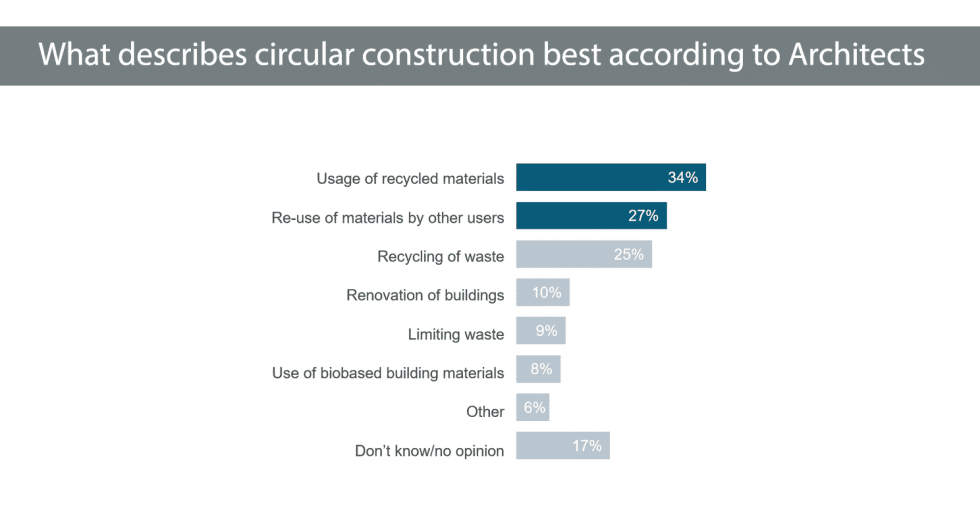
The descriptions architects associate with circularity the most revolve around reusing materials, using recycled materials, and recycling waste. Limiting waste and using bio-based materials were also in the top six of descriptions associated with circular construction. This clearly shows that in their definition of circularity, architects mainly link the concept to the materials used for building construction.
Circularity involves much more than reusing materials
After asking the questions mentioned above, we provided the architects with definitions of circularity and circular construction. We explained circular economyas a system aimed at the continual use of resources and eliminating waste. In circular building construction, all parties involved in the building cycle process take minimising the use and maximising the reuse of building materials and of the buildings themselves into account in every step from the very start of the construction process.
Although using recycled materials is an important aspect of the concept, circular construction involves much more than just the reusability of materials. It also involves reusability of larger products consisting of those materials and thinking of the reusability of entire buildings already in the design phase of the construction process.
A high level of integration of circularity in the building construction process could involve maximising the lifespan of a building, for instance by integrating into the design possible purposes for the building for after it has fulfilled its initially intended purpose. Reusability can also be established by a design that allows a building part to easily be demounted and remounted.
See concepts through the eyes of architects
With the exception of renovation, these aspects of circular construction that involve the reusability of entire buildings or building parts were barely mentioned by architects. For manufacturers of construction materials and products, this is an example of how important it is to truly understand what certain concepts mean to your target groups.
Their view on and definition of broad concepts like circularity and sustainability may differ from your own definition on which you base your marketing and sales strategies. All the more reason to see those concepts through the eyes of your target group. For a full overview of the view on and ideas about sustainability and circularity of architects from eight European countries, we refer you to the Q1 2022 report of USP Marketing Consultancy’s European Architectural Barometer.
Tailored market research
Test whether your circularity message is understood
A shared term does not guarantee a shared understanding of product value. USP can help investigate how architects interpret circularity, test concepts with specifiers and identify the factors that influence acceptance of your proposition.
Branding Research
Research how architects interpret your circularity claims and associate them with your brand, identifying whether the intended value is understood and differentiated.
Product Development Research
Test circular material or building-system concepts with relevant specifiers, exploring how reuse, adaptability and practical application requirements affect their assessment of the offer.
Driver Analysis Research
Assess the relative importance of resource reuse, performance, cost and ease of specification when architects evaluate circular construction products in your category.
Read more

20 June 2022 I Dirk Hoogenboom
European architects are actively involved more in sustainability than in circularity

22 September 2025 I Dirk Hoogenboom
Embodied Carbon: Europe’s Most Adopted Green Practice

04 October 2022 I Dirk Hoogenboom
Proliferation of sustainability certifications causes confusion among architects
12 January 2024 I Jeroen de Gruijl