



Market report
Track architects’ changing priorities
Explore the European Architectural Barometer for research on architects’ material choices, digital adoption, sustainability and prefabrication. Use the available studies to compare established requirements with emerging opportunities and decide which developments warrant closer investigation for your business.
Blogs I published 24 September 2024 I Dirk Hoogenboom
Future Developments in Construction Still Far Away
Even though the construction industry is undergoing significant change, the path towards embracing cutting-edge tech remains slow. What, then, dominates the conversation? How long can we afford to prioritize traditional methods over the potential of emerging technologies (A.I, blockchain, robotics, IoT…)? And how soon can we expect to see widespread integration in construction projects?
All this – and more – we covered in Q2 2024 European Architectural Barometer Report, taking a close look into solutions that will greatly impact the industry. Published in August, the report features insights across 8 European countries, outlining the upcoming focus of architects.
Sustainability First, Innovation Later
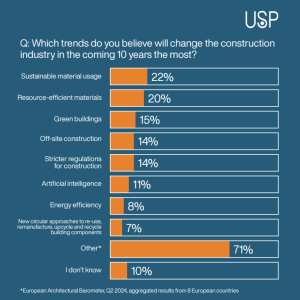
The construction industry is, we well know, notoriously traditional and slow to adapt. When asked about what’s driving the industry, architects think about brassbound trends: it’s all about sustainability (22%), resource-efficient materials (20%) and off-site construction (14%), with innovative technology having yet to gain traction. A.I. was, for instance, ranked 6th in terms of anticipated trends, with only a shy 11% mentioning it spontaneously. While our stats show 6-7 spiking trends that will shape a decade of construction, it’s important to note that many architects – some 70% of them when prompted – also mention other factors than the ones included in the overview.
Advanced Technologies Taking A Backseat
Despite the buzz surrounding A.I, drone tech, nanotech, augmented reality, robotization, blockchain, 3D-prints… architects are keeping them on the sidelines. On a wider scale, most are overwhelmingly ignored, with only IoT ranking 6th in ongoing projects (with 29% of all European architects mentioning that this is already strongly or very strongly considered in their projects). The trends preceding it are stricter regulations (61%), green buildings (55%) and off-site construction (37%). Adoption rates for the rest – say, blockchain, robotization and nanotech – seem far down the line, with over 50% of architects claiming, when prompted directly, not to consider them at all.
Timeline for Integration
As far as how long will take, the expectancy is late. The majority of architects don’t really see advanced technologies implemented in the near future. Generally speaking, we do see certain elements either happening or happening in the next three years: drones, IoT, A.R. and A.I. But they are vastly overshadowed by green buildings (57%), off-site construction (54%) and lower on-site garbage production (46%). For comparison, blockchain, robotization and nanotech span 10% – 14%, meaning more advanced trends will come up in the next ten years.
Conclusion
The European Architectural Barometer underscores that sustainability continues to lead the conversation and more disruptive technologies – though highly anticipated – still have a long road ahead before becoming commonplace in the construction industry.
Tailored market research
Invest in innovations architects are ready to use
New technologies compete with practical project priorities. USP can help you investigate where demand is developing, test concepts with specifiers and distinguish promising target groups before committing resources to your next construction innovation.
Market Exploration Research
Explore how technology adoption, competitors and project requirements differ across construction markets to identify realistic opportunities for your next innovation investment.
Product Development Research
Test emerging material or technology concepts with architects to understand relevance, perceived benefits and barriers before advancing product development decisions.
Market Segmentation Research
Identify architect groups with different innovation readiness, project portfolios and priorities so your proposition reaches the specifiers most likely to consider it.
Read more

04 March 2026 I Dirk Hoogenboom
Most Architects Now Use AI. Here’s What They’re Actually Doing With It.
17 April 2026 I Dirk Hoogenboom
Prefab in Europe: Growing to 30%, but Not Fast Enough
22 September 2025 I Dirk Hoogenboom
Embodied Carbon: Europe’s Most Adopted Green Practice

24 September 2024 I Jeroen de Gruijl