


Market report
Identify the voices shaping specification
Explore the Q1 2026 architectural decision-making report for insight into stakeholder roles in construction projects. Understand how architects view their own influence and other decision-makers, helping manufacturers assess where product and brand choices develop across the specification process.
Blogs I published 15 February 2023 I Dirk Hoogenboom
Building Construction Decision Making: Who’s in Control?
Building Construction Decision Making: Who’s in Control?
The main country findings come from the 2022 European Architectural Barometer. Separate sections add contractor self-assessments from H2 2020 and a sustainability-influence discussion published in November 2023. These describe perceptions and roles, not observed shares of purchases.
The process of designing and constructing a new building can be rather complex due to the number of different parties involved. The architect used to be the most important decision-maker throughout that process, especially regarding material choice. However, the central role of the architect is not a given anymore.
The role of the architect has been changing over the years. Other parties have been gaining influence on the decision on materials and brands to be used. To reach those target groups as well, manufacturers and brands of construction materials have to adjust their marketing.
But who are these ‘other parties’ that influence decisions in the design and construction process of new buildings? The answer can be found in the report of USP Marketing Consultancy’s European Architectural Barometer, which focuses on decision-making in the construction process. According to architects from eight European countries, building owners and main contractors are the most important co-decision makers.
The Influence of Building Owners and Main Contractors on Material and Brand Decisions
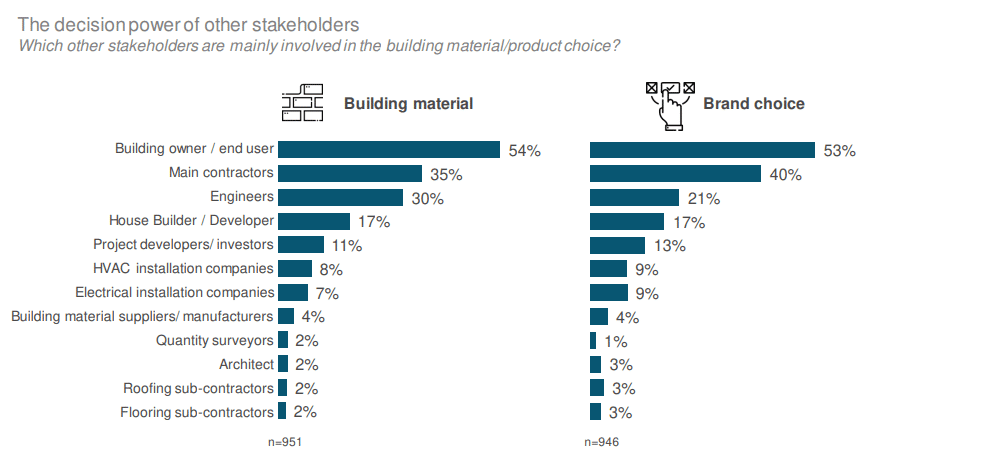
Fig. 1: 2022 stakeholders mainly involved in the building material and brand choice, according to architects in eight European countries.
On average, building owners and main contractors are considered the most important stakeholders when deciding on both materials and brands. There are some significant differences per country, however.
Looking at brand choice for certain building materials, for instance, 78 % of architects in the Netherlands say main contractors are the main stakeholders. In Germany, on the other hand, only 9% of architects mentioned main contractors. In Germany and the UK, building owners or end users are the most important stakeholders when choosing the brand for building materials, as mentioned by 76% of architects.
78%
of architects say main contractors are the main stakeholders in brand choice
9%
of architects mentioned main contractors
76%
say building owners or end users are the most important stakeholders in brand choice
The Contractor Perspective: H2 2020
The European Contractor Monitor asked contractors about their own influence. This is a different professional sample from the architects above.
When thinking about the design process as well as building materials and product specifications, the traditional tendency is to focus on architects and/ or engineers. However, slowly but steadily growing construction trends are empowering European contractors and increasing their influence in the full project cycle. Contractors see themselves as most influential in product and brand choice. More than 50% of the contractors have a say in the design process, and more than 80% have the power to influence product or brand specifications.
Developer Contractors and Final Decisions
The increasing number of developer contractors, the type of contractors who are appointed to develop and carry out the full project cycle, enables a more integrated value chain, which empowers the contractor even more in the decision-making process. Confirming this, contractors who are also developers indicated they are more influential in the final decision-making process than non-developers.
In France, which has the highest share (38%) of developer contractors, together with the UK, contractors also have the highest decision-making power. French contractors are the most influential in final decision-making in the design process and product and brand specification compared to the other European countries. With a vast majority of 75% of contractors indicating themselves as the end-decision makers, they are especially powerful in the final decision of brand choices.
European contractors believe that the changing dynamics of the construction sector will increase their role in the decision-making unit even more. Aside from an increasing number of contactor-led design and build projects, other trends, like the increasing importance of and demand for sustainability in construction, are also affecting and increasing the power of contractors in product and brand decisions. All the more reason for manufacturers to engage with contractors and align their way of working and portfolio with the construction trends that move the world of the contractor.
For more information on trends affecting the DMU in the construction sector, we refer you to the H2 2020 report of USP Marketing Consultancy’s European Contractor Monitor.
Who Influences Sustainable Construction? The 2023 Discussion
Across Europe, contractors consistently point to architects as the most influential group when it comes to sustainable construction, named by 28% of respondents. National governments follow at 23%, with contractors themselves in third at 16%.
But zoom in by country, and things shift. In Germany and Spain, architects are the top influence. In France, contractors rate themselves higher. In the Netherlands, it’s the government and local authorities leading; architects don’t even make the top three.
Government and Other Stakeholders
National and local governments are also important influences on sustainable construction. The role of government also varies by country. However, in France and Spain, we’re seeing a different story – government falls back, and industry takes the lead.
Contractors are increasingly noticing influence from other corners – developers, material manufacturers, even end users. In Italy and Poland, building owners and manufacturers are gaining visibility as drivers of sustainable decision-making.
What Building Material Suppliers Can Contribute
The supply chain also plays its own role – especially the companies that make the materials.
Providing clarity, educating the market about sustainability, and providing sustainable materials are key services construction companies expect from building material suppliers. They can play a vital role in stimulating and supporting construction companies in working in a more sustainable way.
Countries must significantly boost investment in education, encourage people to choose a career in sustainable construction, and expand training programs to attract and train a skilled workforce capable of implementing green technologies and sustainable practices.
Digitalisation’s Impact on Co-Decision Making in Building Construction
We have seen main contractors gaining influence in the design and construction process for a while now. This trend is especially apparent in the Netherlands and Belgium. The increasing involvement of building owners is a more recent development that is most visible in Germany, the United Kingdom and Italy.
Although there are many ways to explain the rising influence of these parties, digitalisation is a major underlying factor for both. On the one hand, there is the digitalisation of the construction process, for instance in the form of Building Information Modelling (BIM). This allows executing stakeholders like main contractors to be involved in earlier stages of the design and construction process.
On the other side, numerous digital sources allow building owners to easily find solid and relevant information on construction materials, systems, their implications, and the brands producing them. As a result, building owners can be well-informed decision-makers, instead of leaving most decisions on materials and brands to architects.
The Future of Building Construction Decision Making: What Manufacturers and Brands Need to Know
We expect parties other than the architects to continue gaining influence at earlier stages of the construction process. That is partly based on the above connection with the digitalisation of the construction sector, but also on other trends.
Technological development of materials and systems causes buildings to be increasingly complex. Architects cannot be specialised in every technical aspect of a building. That means that they will have to rely on specialists like engineers more often, who will consequently gain influence on brand decisions. At the same time, technological developments create more options for building owners, meaning they will have more decisions to make at the start of the design process as well.
For manufacturers and brands of construction materials and systems, it is very important to keep track of these changing roles and influences of stakeholders in the construction process. Knowing who influences the brand decision for your product group will allow for effective and efficient marketing strategies. For a full overview of the changing decision-making units in building construction, we refer you to the 2022 report of USP Marketing Consultancy’s European Architectural Barometer.
Also, read our blog for more info about trends that are shaping the future of construction industry
Tailored market research A product can be specified, challenged and approved by different people. USP can help you map those roles, understand the criteria behind decisions and identify the customer groups your commercial approach needs to address. Map material and brand decisions across project stages, identifying the influence of architects, contractors, owners and other stakeholders on your product category. Assess which selection criteria carry most weight for different construction stakeholders, helping explain why a product is considered, specified or replaced. Identify decision-maker groups by role, project context and needs to focus your proposition on the audiences most relevant to your specification opportunity.Reach the people behind the specification
Customer Journey Research
Driver Analysis Research
Market Segmentation Research
Read more

04 April 2025 I Dirk Hoogenboom
Construction Decisions Aren’t Simple – Why Market Research Gives a Competitive Edge

06 February 2021 I Henri Busker
Private: The role of main contractors is becoming more important

15 November 2023 I Henri Busker
Private: Who are the main influencers for sustainable construction?

22 April 2025 I Dirk Hoogenboom