

Market report
Understand digital needs in mechanical installation
Explore the European Mechanical Installation Monitor for research on HVAC installers’ working practices, BIM, purchasing and support needs. Its report range helps manufacturers assess how digital requirements differ across the professional audience they want to serve.
Blogs I published 02 July 2024 I Dirk Hoogenboom
BIM Adoption Among European HVAC Installers: the 2024 Benchmark
The headline adoption figures come from Q1 2024. The installer profiles below come from Q1 2022 and use FTE company-size groups and turnover shares. These are separate research waves, not new 2026 or 2027 measurements.
In a continuously more digital world, the construction and installation industry is much slower to adapt than other industries. The nature of the industry (conservative) and the way we build (still a large share is traditionally built and renovation is a large part of the construction industry) slows down the adoption rate.
When discussing digitalization in the construction industry, BIM (building information modeling) is an important indicator. So to what extent are HVAC installers using BIM? And how did this develop over time? These, and many other questions, are answered in the Q1 2024 report from the European mechanical installation monitor on BIM.
BIM adoption remains low
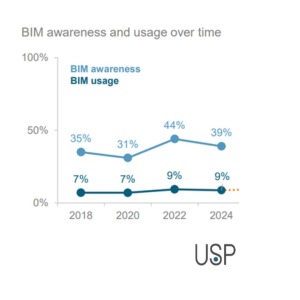
One of the key findings of the report is that BIM adoption remains on the low side among European mechanical installers. On a European level, the share of installers using BIM is relatively low at 9%. However, there are significant country differences, with installers in the Netherlands using BIM much more often. About 22% of Dutch mechanical installers are BIM users. Furthermore, BIM usage is strongly correlating with company size. On a European level, only 3% of small installers (up to 4 employees) use BIM. The biggest companies use BIM much more often, with 22% being BIM users (15 employees and more).
Adoption speed is slow
If we look at the evolution of BIM usage among mechanical installers, it’s a very slow process. On a European level, in 2018 7% of all installers used BIM. This increased to 9% in 2024. For comparison, if we look at architects, BIM usage in 2017 was already 30% and it increased to 45% in 2023. There are some key differences between these target groups of course. Architects focus more on new build and are thus confronted with BIM more often. On top of that, they do a lot more ‘designing’ than the average installers.
Who Was Using BIM? The Q1 2022 Profile
To get a clearer idea of future BIM adoption, it pays to know more about the installation companies that are already using it. Who are these installers who invested money, effort and time to start using BIM? To find out, we interviewed HVAC installers from six major European markets on their experience with BIM for USP Marketing Consultancy’s European Mechanical Installation Monitor.
Larger Companies Were More Likely to Use BIM
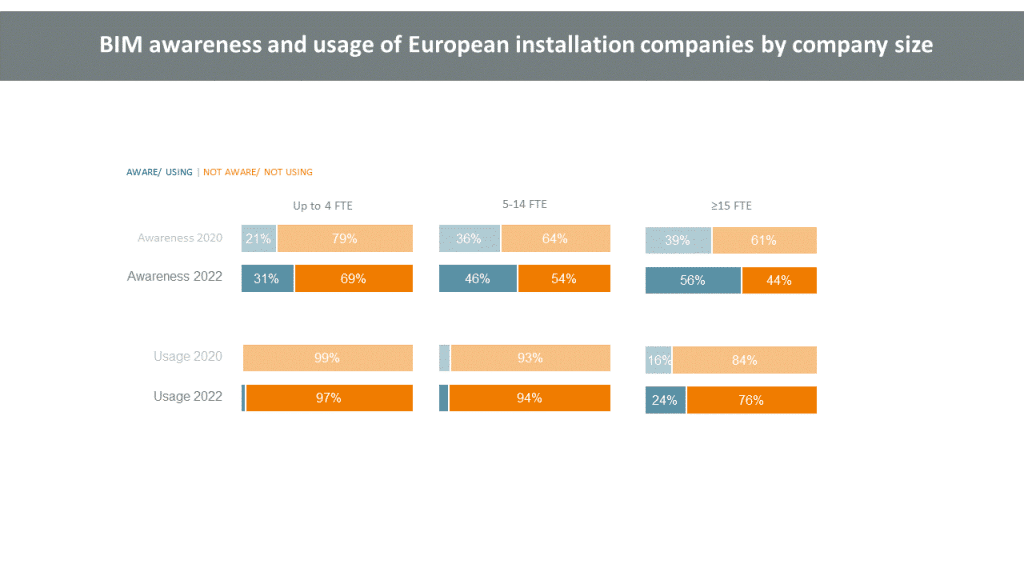
Looking at the size of installation companies, BIM usage is almost non-existent among the smallest, as only 3% of installation companies with a size of 4FTE or less report to use it. The share of users is larger among medium-sized installation companies, but still only a fraction (6% among installation companies sized 5-14FTE).
The real BIM action is found among the larger installation companies (15FTE or more), of which BIM usage has grown from 16% in 2020 to almost a quarter in 2022. For these larger companies, the investment necessary to acquire BIM software and train or hire a BIM specialist may be more feasible, but there are other reasons why current BIM users are mainly the large installation companies.
Project Mix: Turnover from New-Build and Non-Residential Work
On average, the BIM-using installation companies are getting 57% of their turnover from new-build projects, whereas installation companies that are not working with BIM are more involved in renovation. Also, BIM-using installers get about half of their turnover from non-residential projects, whereas non-BIM-users get 61% of their turnover from residential projects.
It makes sense that BIM is already used a lot more in large-scale non-residential new-build projects, than in smaller residential and renovation projects. Larger installation companies are more often involved in those large non-residential new-build projects. That means that, aside from having the necessary means to invest, the larger companies have more of an incentive to adopt BIM as well.
The above also explains why BIM usage is not exploding but only steadily growing. BIM is mainly used for larger non-residential projects, which are done by larger installation companies. The smaller installation companies, for whom starting with BIM is rather expensive and offers less reward in their smaller residential or renovation projects, are a lot more numerous than the larger installers.
The 57% new-build figure and the residential/non-residential percentages describe turnover within installer groups; they are not shares of all installers adopting BIM. Likewise, the 2022 “almost a quarter” large-company finding should not be treated as the same measurement as the 2024 figure of 22%.
Implications for Manufacturer Support
The 2024 report also covers levels of detail, support needs and BIM features used. Company size and project mix help identify which installers are likely to need that support.
What else is in the report?
In the full Q1 2024 report of the European mechanical installation monitor report, many more BIM-related topics are covered, like the LOD, support needs, features used, and many more. If you are interested in learning more, feel free to contact us or take a look at the Q1 2024 European installation monitor BIM report page.
Tailored market research Digital requirements depend on the projects installers undertake and the partners they work with. USP can help identify relevant mechanical customer groups, test support concepts and understand where product information fits their decision process. Identify HVAC installer groups by project mix, company size and digital requirements to distinguish those needing BIM resources from customers with other priorities. Test BIM-related tool and information concepts with mechanical installers, exploring their perceived benefits and the practical requirements of the projects they undertake. Map how HVAC installers obtain and assess digital product information within project teams, identifying the points where manufacturer support could be more useful.Find the HVAC customers who need BIM support
Market Segmentation Research
Product Development Research
Customer Journey Research