





Market report
Follow contractor purchasing decisions
Explore the H2 2025 contractor report for insight into purchase channels, spending allocation and ordering behaviour. Its focus on general contractors helps manufacturers and distributors assess how wholesale and direct routes fit local market structures and customer choices.
Blogs I published 19 February 2024 I Henri Busker
The buying behaviour of European contractors remains very traditional
The European construction industry is, in many aspects, a very traditional sector. This also holds true for the buying behaviour of European contractors.
The main findings below come from the H2 2023 European Contractor Monitor, covering contractors with five or more employees. A separate historical section compares the 2018 and H1 2021 purchasing waves; it does not describe a new 2026 survey.
In our H2 2023 report of the European contractors monitor (based on interviews with contractors with 5 or more employees) we have focused on their buying and ordering behaviour. This comprehensive analysis reveals intriguing insights into the share of contractors’ spending habits across various channels and countries.
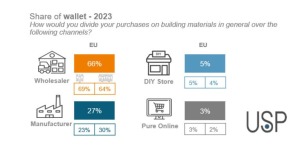
H2 2023: Channel Usage and Share of Wallet
What immediately becomes visible is the traditional route-to-market, which is dominant in the European construction industry. If we look at the share of contractors buying at various channels, it becomes clear that the specialized wholesale is very dominant. More than 90% of the surveyed European contractors buy via this channel. The second most used channel is direct supply via manufacturers with 65%. DIY stores and Pure online players like Amazon have a significantly lower share of contractors buying there.
However, it is even more important and interesting to look at the share of wallet.
The specialized wholesale emerges as the undisputed leader, commanding approximately two-thirds of the total share of wallet among European contractors. This dominance underscores the pivotal role these wholesalers play in serving the needs of contractors across the continent
Direct supply from manufacturers follows, claiming 27% of the share of wallet, signifying a significant portion of contractors’ expenditures flowing directly from the source.
In contrast, DIY stores and pure online retailers capture only a fraction of the total share of wallet, indicating a preference among contractors for specialized channels.
Country-specific variations add another layer of complexity to the analysis. The Netherlands and Belgium lead in the share of wallet spent via specialized wholesalers, while Germany exhibits the lowest share in this regard. Direct supply from manufacturers, however, sees its highest traction in Germany. UK contractors display the highest share of wallet for pure online channels, but the adoption of pure online channels remains relatively low in countries like Germany, Italy, and Belgium.
While the overall distribution of spending across channels remains relatively stable, there are notable shifts, particularly in the increasing share of wallet attributed to direct supply by manufacturers. Slight increases are also visible for pure online and DIY stores, but the absolute share of wallet remains very low.
The Earlier Shift: From 2018 to H1 2021
Be that as it may, that does not mean that nothing has changed in the shares of wallet contractors spent at the various purchasing channels. From that perspective, a European trend towards the most traditional way of purchasing, the three-tier system, can be seen when comparing the results of the H1 2021 report of USP Marketing Consultancy’s Contractor Monitor with our measurement of purchasing behaviour of contractors from eight European countries in 2018.
Purchasing Amounts Shifted Back to Wholesalers
The traditional way of purchasing from wholesalers, who in turn purchase from manufacturers, has always accounted for the largest share of purchases by contractors. However, when comparing with 2018, that share has even increased on a European level, while the share of wallet contractors spent directly at manufacturers has declined by roughly the same amount.
Even though the shift from purchases directly from manufacturers towards purchases at wholesalers does not seem to occur in all countries, the fact that it is present in large markets like Germany and Spain shows that it is not just a one-country anomaly but a trend in the European results. The question remaining is why this shift happened?
Possible Explanations During the Pandemic
Even though contractors stated that COVID-19 did not change their purchasing behaviour, there may still be an effect, or actually an amalgamation of direct and indirect effects of the pandemic at play here. For instance, the pandemic caused material shortages at manufacturers, which destabilised their stock availability and delivery. In such uncertain times, the wholesaler around the corner offering alternative brands in case of stock problems may be the more secure option for a busy contractor.
Aside from more secure availability and delivery, familiarity may have played a role as well. A lack of personal contact with manufacturers during the pandemic may have caused contractors who order from both manufacturers and wholesalers to order less from the former and more from the latter. Especially in more traditional markets like Germany, when a pandemic reduces possibilities for contractors to have personal encounters with manufacturers, but direct advice from the familiar nearby wholesalers is still available, it stands to reason that the share of wallet dedicated to wholesalers goes up.
The above shows that there are multiple interplaying explanations for the shift in the share of wallet that contractors dedicate to certain purchase channels. With that many variables, some temporary and others more lasting trends, it is not surprising that the trend seen in Europe as a whole is not as strong or even present in every one of the eight countries we monitor.
The H1 2021 shift toward wholesalers and the later H2 2023 increase in direct supply describe different survey periods. Channel usage and share of spending also answer different questions.
What the Findings Mean for Channel Strategy
The H2 2023 findings suggest that specialized wholesalers will continue to maintain an important role in serving European contractors. It will depend on the market dynamics to what degree we will see a shift occurring more prominently.
For example, a market crisis may prompt contractors to explore alternative channels and shop around to save money. But in times of favourable market dynamics, loyalty to traditional channels, notably specialized wholesalers and direct manufacturer supply, remains steadfast.
Tailored market research
Build your channel strategy around contractor spending
Broad channel usage can hide important differences in spending and supplier choice. USP can help you map contractor buying routes, investigate local distribution opportunities and identify the factors that make your offer competitive.
Customer Journey Research
Map how contractors select suppliers and order materials, including the roles of wholesalers and direct manufacturer relationships across different product and project types.
Driver Analysis Research
Compare the importance of availability, service, price and other supplier-choice criteria to focus improvements on factors that matter to your contractor customers.
Market Exploration Research
Examine distribution structures and competitor routes in target construction markets to assess where wholesale partnerships or direct supply offer a realistic commercial opportunity.

Read more

15 September 2021 I Dirk Hoogenboom
Pure online purchase channel used more by contractors due to COVID

19 August 2025 I Dirk Hoogenboom
How European Contractors Source Information

30 April 2025 I Dirk Hoogenboom