
Market report
Understand the professional handyman buyer
Explore the Handyman Insights Monitor for research on how professional handymen choose products, suppliers and information sources. Understand the role of quality, convenience and price pressure before refining your product, distribution or communication strategy for this audience.
Blogs I published 12 December 2024 I Dirk Hoogenboom
Buying Behavior of Handymen
In a market strained by labor shortages, the adaptable handyman is gaining importance across Europe. These multi-skilled workers are stepping up to handle smaller projects for private homes, from painting to minor repairs, filling in the gaps left by specialized contractors who are either booked out or charge higher fees. So what are they looking for as buyers?
The opening purchasing and brand findings were published in December 2024. Later sections add the 2021 European Handyman Monitor, based on 1,700 handymen in seven countries. The two periods are kept separate: channel usage, budget share, online ordering and brand preference are different measures.
According to the 2024 European Handyman Insights Monitor, they’re very clear about their priorities: they prefer established, high-quality brands, with 48% of them showing a preference for professional-grade tools and materials.
Private Labels Versus Branded Products in the 2024 Report
Quality, reliability and after-sales support remain key priorities, especially in a sector where durability and performance are paramount. Yet, opinions on private labels vary considerably depending on the country, age group and type of handyman.
Branded products are seen as better-quality products than private label products are, especially among Polish and French professionals (30% and 24% respectively). Across the board, handymen also believe branded options come with added services (22%), extended warranties (20%), a technical edge (20%) and more innovation (20%) compared to private label products, though there are some differences.
Dutch handymen, for instance, are less focused on brands’ technical superiority, while handymen in the UK are less outspoken about the innovative edge brands offer.
Age also plays a role in these preferences: baby boomers and Gen-X overwhelmingly prefer branded products, valuing the perceived quality and support, while Gen-Y handymen are slightly more open to private labels, though a majority still favor branded products.
Lastly, there is little difference between multiskilled handymen and specialists in their product preferences. Both groups lean towards branded products, with specialists slightly more likely to value the innovative and technical advantages that branded products offer.
Sustainability and Online Ordering in the 2024 Findings
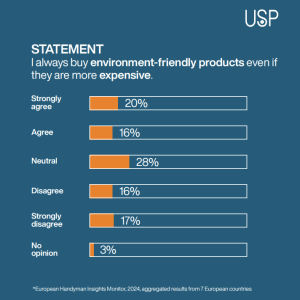
Truth be told, sustainability is less of a focus, with most handymen feeling indifferent towards environmental features, but there are exceptions. Italian, Polish and Spanish handymen, seem to care more about sustainability than their colleagues from North-Western Europe (55%, 25% and 20% respectively).
Handymen from Germany and the Netherlands are less inclined to buy brands that care for the environment, and they also show less preference for a wholesaler/ distributor who offers sustainable options than other handymen do. We also see that baby boomers care more for the environment than other generations (28%).
Though handymen are traditionally accustomed to in-store purchases, online ordering is gradually becoming more popular. While only 16% in the 2024 discussion order most of their products online, 32% show a preference for wholesalers that offer easy online ordering platforms. In the UK and Germany – countries where e-commerce has gained a stronger foothold – handymen are more likely to shop online, and this trend is especially pronounced among Generation Y, generally more open to digital solutions compared to Baby Boomers.
The 2021 Channel Baseline: More Jobs Means More Shops
The first European Handyman Monitor interviewed 1,700 handymen from seven European countries. Its 2021 channel findings explain where a broad mix of jobs could lead to a broad mix of suppliers.
General Building Material Wholesalers Were Used Most
At first sight, it appears that the traditional general building material wholesaler is the favourite purchase point, as nine out of ten European handymen buy there. The fact that they spend nearly half of their budget there on purpose makes this purchase channel the clear favourite. Interestingly, the next five purchase channels in the research, ranging from specialised wholesalers and merchants to DIY stores, are each used by roughly around half of the handymen, and they spend just under a tenth of their budget there on average.
This is where handymen contrast with for instance installers or painters. From our other monitors we know that those more specialised professionals generally use fewer purchase channels and spend a much higher share of their budget at one wholesale channel specialised in the products for their main activity. Handymen, on the other hand, tend to shop at a wider variety of channels. At the risk of sounding like a broken record, with their purchasing behaviour, handymen prove again to be more diverse.
The above contrast between handymen and more specialised professionals is easily explained. Handymen are involved in a wider array of construction activities than specialised professionals, which means they need materials and products from a wider array of product groups. Consequently, they acquire these at a wider variety of purchase points than professionals that mainly focus on one activity.
That pattern of more jobs means more shops is also reflected in the handymen’s responses: the number of activities handymen are involved in differs vastly per country. German handymen, who perform an average of 5.1 different construction activities, are the most specialised, whereas UK handymen, who perform 12.2 activities on average, are the most generalist handymen. These differences are reflected by purchasing behaviour of handymen in both countries. The more specialised German handymen use fewest purchase points, 3.1 on average, whereas the more generalist UK handymen also use the most purchase channels, 5.3 on average.
One Fifth of the Budget Went to Consumer Channels
More than half of European handymen report to use Hardware stores and DIY stores to purchase products needed for their projects. Pure online shops are used by just over a quarter of European handymen. These shares differ significantly per country though. DIY stores are reportedly used by a whopping 70% of handymen in Germany and the UK, but only by 40% in the Netherlands, for instance. Similar differences can be seen in Hardware store and pure online shop usage.
When looking at the share of budget spent at these individual channels, significant differences can be seen per country as well. 9% of the total budget of European handymen is spent at European DIY stores. In Germany, with the largest share of handymen reporting to use DIY stores, the share of budget spent there is 16%. In the Netherlands, Handymen only spend 4% at DIY stores, but they spend a whopping 12% of their budget at hardware stores.
What differs less per country is the share of budget spent at DIY stores, hardware stores and pure online shops combined. European handymen spend close to one fifth of their budget at these consumer channels. Looking at individual countries, this share ranges from 14% in Spain, to 22% in Germany and Poland.
What This Means for Professional Brands
Professional brands of construction and installation products and materials may be reluctant to place their brand in purchase channels for consumers, and for good reason. After all the effort to create the image of a professional brand, that image may be damaged when your products are found next to brands for general consumers in a DIY or hardware store. However, those professional brands may be missing out on selling to the numerous European professional handymen that use consumer purchase channels.
Given the vast number of handymen in Europe, around one fifth of their budget spent at consumer channels is a serious amount of money. Even though there is good reason for a professional brand to avoid consumer channels to uphold its professional image, the above might make them reconsider. If you produce products that are often used by handymen and your professional brand is available in for instance DIY stores, chances are high the handymen shopping there will find and buy them.
The DIY stores are an especially valid example here because they have another characteristic that is important for the multi-skilled handymen. Given the variety of products they use, purchasing those products takes time. Finding many different product groups in one place saves time, and 55% of European handymen state that one-stop shopping is becoming more important. General wholesalers might have that characteristic, but the DIY store around the corner can also be a one-stop shop for many items handymen need.
For suppliers and brands, the message is clear: handymen prioritize quality, value customer service and are gradually leaning toward digital solutions. Although sustainability isn’t a top concern for most, there is room to introduce eco-friendly options as the industry evolves.
Tailored market research
Build your offer around handyman priorities
Professional handymen combine consumer-facing work with distinctive product and supplier needs. USP can help map their purchasing process, identify meaningful customer groups and determine which attributes matter most when they compare your offer.
Customer Journey Research
Trace how handymen identify products, compare suppliers and place orders, including the transition between store advice and online purchasing in different markets.
Driver Analysis Research
Assess the importance of professional quality, availability, service and sustainability in handyman purchase decisions to guide priorities for your product and channel offer.
Market Segmentation Research
Identify handyman groups with different task portfolios, purchasing habits and product preferences, helping you distinguish valuable audiences beyond simple age or country averages.