


Market report
Explore changes in material specification
Explore the European Architectural Barometer for research on material usage, sustainability and architects’ specification behaviour. The available studies help manufacturers assess differences between products and markets and investigate how evolving design priorities could affect their portfolio and commercial planning.
Blogs I published 06 June 2024 I Dirk Hoogenboom
Trends in construction material usage
Trends in construction material usage
Architects can have a direct impact on building sustainability by choosing and specifying more sustainable and circular materials in their projects. This is why every two years we conduct a survey about trends in material usage in the European architectural barometer.
This article brings together Q1 2024 material-use expectations, the earlier Q2 2022 study, and innovation findings published in November 2023. Expected use refers to the five years following each survey; it is not a measurement of current market share.
Architects expect to specify fewer different materials
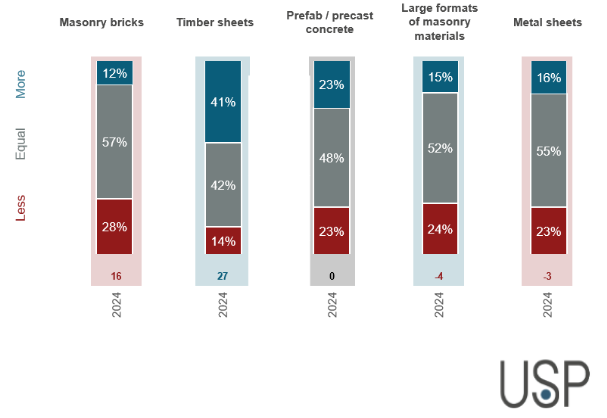
There is one clear trend visible amongst architects in the key 7 European countries the European architectural barometer covers; Architects expect to use a lower variety of different materials. This trend has already been visible since 2020 and continued in 2022 and in 2024.
Sustainable materials are expected to be prescribed more often
Even though the variety of materials that architects expect to use is decreasing, some materials are expected to be used much more often. It might not come as a surprise that these are mostly the more ‘sustainable’ materials like wood based solutions and insulation made from natural materials. Also solutions like water and energy saving bathroom fittings, air-condition and screens and shutters are expected to be used more often in the five years following the 2024 survey.
Country differences are visible
As mentioned, in all of the 7 countries included in this research, the general trend of using less types of materials and more sustainable ones are visible. However, there are some country differences. For example, when it comes to the building envelope, timber sheets are expected to be used much more in all countries except for Spain and Italy. Masonry bricks are expected to decrease in all countries except for the UK.
If we look at insulation, it’s clear that in most countries PUR/PIR and Polystyrene foams are showing a negative trend when it comes to their usage in the five years following the 2024 survey. However, in France architects foresee a slightly higher usage of PUR/PIR and in Italy architects state that the usage of Polystyrene foams will stay flat.
Other material groups
In the full report a wide variety of materials are measured, too many to discuss all of them in detail. The product groups that are represented in the report are: Building envelope, Façade materials, Metals, Pitched roofs, Flat roofs, Insulation materials, Bathrooms, Flooring, Installation & climate control, Control and smart home solutions and Finishing materials and products. Within these product groups, many different materials are presented.
The Earlier Q2 2022 Material-Use Expectations
The 2022 wave covered eight countries; the 2024 article covers seven. These are separately dated expectations, not a single like-for-like measurement of material demand.
Every other year, we dedicate one quarterly report of USP Marketing Consultancy’s European Architectural Barometer to material usage in building construction. For that report, we measure architects’ expectations of materials specified for building construction in the coming five years to construct a clear picture of the developments in materials used. Based on our interviews with architects from eight European countries in the second quarter of 2022, we can conclude that architects generally expect to specify and use fewer materials in the coming years.
Across all countries, architects expect to use fewer materials for certain purposes or elements of a building. That is, they expect to use a smaller variety of types of construction materials. Those expectations started to appear in our measurement in 2020. In the 2022 measurements, we see that for the coming years, architects generally continue to expect using a smaller variety of materials.
This is the case for many materials in the ten product groups or building parts we interviewed architects about. Looking at building façades, for instance, architects expect to specify less concrete, plaster, architectural glass, metal and fewer bricks and external drywall systems. The only product type they expect to specify more is façade panels. A similar expected reduction of the majority of specified materials can be seen in both pitched and flat roof materials, flooring materials, metals in general, and quite a few materials used for the building envelope.
Exceptions show the quest for sustainability
That sustainability trend is reflected by the few product or building part categories in which a majority of materials are actually expected to be specified more. In the category of insulation, for instance, architects expect to specify all types of insulation material more, except for polystyrene foams. As for installations and climate control, architects also expect to specify all sorts of materials and systems more, except for gas boilers and radiators.
The sustainability trend is not just reflected by better insulation, more heat pumps and fewer gas boilers, however. Looking at other categories, we see that architects expect to opt more often for renewable materials like timber, and fewer plastics and other oil-based materials. These are but few examples of the long list of materials we asked architects from eight European countries about. For a full overview of expected developments in materials used for building construction, we refer you to the Q2 2022 report of USP Marketing Consultancy’s European Architectural Barometer.
Which Solutions Architects Considered Innovative in 2023
In the research discussed in November 2023, architects named innovative sustainable solutions already being used. A share of mentions measures recognition of a solution as innovative, not its installation rate or market share.
To answer demand for sustainable construction, many companies invest heavily in developing sustainable construction materials and products. Consequently, architects are confronted with a multitude of innovative solutions for more sustainable and circular construction to choose from. The question is, which innovative solutions are being adopted?
Energy-Saving and Renewable Solutions
To find out, we asked architects from eight European countries what solutions and products for sustainability and circularity are already being used. Given the recent, rather dramatic increases in energy prices, it does not surprise that architects mention insulation the most. Similarly, it does not surprise that solar panels are the second-most-mentioned solution.
What is interesting is that architects specifically mention bio-based insulation. That focus on bio-based products shows that this is not just a reactionary concern about energy savings. It also betrays a deeper interest in the origin of the material, and greater value is placed on renewable sources.
Circular Materials
The third most mentioned are recycled and reused materials, which is a broader category of materials linked to sustainability. Recycling and reusing materials is also an essential practice for circular construction, which strives for continuous reuse of materials.
Interestingly, among the responses, we find some specific mentions of circular or reused materials. Circular concrete, insulation from waste material, and circular wooden frames are mentioned by 6%, 6%, and 5% of architects, respectively. These are not very high percentages, but together they show that circularity is gaining interest.
It has to be mentioned though, that the above-mentioned circular or reused materials are mainly mentioned by French architects. For instance, 21% of French architects mentioned circular wooden frames as an innovative solution that is currently being used, while the share of architects mentioning this in other countries varies from 0% to 6%.
What Counts as Innovative Differs by Country
Clearly, country differences show that the innovative solutions regarding sustainability and circularity that are currently used, according to architects, differ from area to area. For instance, France is more material-based when looking at sustainability, as bio-based and cross-laminated timber, and the aforementioned circular and reused materials are mentioned a lot.
In Italy and Germany, on the other hand, the focus is more on renewable energy, as solar panels are currently mentioned the most as innovative solutions that are already being used, according to architects. On the other hand, none of the Dutch architects mentioned solar panels, which is a great example of the caution that is needed when interpreting these results.
The fact that Dutch architects do not mention solar panels as innovative solutions that are already being used does not mean solar panels are not being used. What this indicates is that solar panels are so normal in the Dutch market that architects do not consider them innovative solutions any more, but just normal solutions.
This shows how important it is for manufacturers of materials and solutions for more sustainable and circular building construction to know the fine details of and differences between specific markets to truly understand the playing field. For a full overview of architects’ thoughts and attitudes about sustainable and circular construction and which innovative sustainable solutions are currently hot in eight European countries, we refer you to USP Marketing Consultancy’s European Architectural Barometer.
Conclusion
Even though the sense of urgency for improvements of the sustainability level of buildings and houses in Europe dropped somewhat after peaking in 2022-2023 (look for example at the adoption rate for heat pumps), we expect that architects will continue to focus on prescribing more sustainable materials and as a consequence a smaller variety of different types of materials. Especially materials that utilize fossil fuel (i.e Oil) as it’s major component are under the highest pressure.
In the full report, Q1 2024 European architectural barometer on trends in material usage, you can find all of the mentioned products groups and it’s associated materials for 7 key European countries (Italy, Spain, France, Belgium, the Netherlands, the UK and Germany). The report also includes the building-volume predictions for 2024 and 2025 that were made at the time.
Tailored market research
Turn material trends into focused portfolio decisions
A broad move toward sustainability can produce different outcomes for individual materials. USP can help you estimate category opportunities, investigate local specification criteria and test product concepts with the architects who influence demand.
Market Size Research
Estimate the market opportunity for specific materials and applications by country, giving portfolio planning a defined value or volume basis beyond adoption expectations.
Driver Analysis Research
Assess how architects weigh sustainability, performance, cost and availability when specifying materials, helping clarify the strengths and weaknesses of your proposition.
Product Development Research
Test new material concepts with target specifiers to understand application needs, relevant benefits and barriers before choosing where to focus product development.
Read more

12 October 2022 I Dirk Hoogenboom
Private: Sustainable construction trend: architects continue to use fewer but more sustainable materials

22 September 2025 I Dirk Hoogenboom
Embodied Carbon: Europe’s Most Adopted Green Practice
17 July 2024 I Dirk Hoogenboom
Are Lumber Prices Going Up or Down in 2025?
26 July 2024 I Dirk Hoogenboom