

Blogs I published 19 November 2026 I USP Marketing Consultancy
Van Westendorp, Gabor-Granger or conjoint: which pricing method fits your building-product decision?
You are launching a new building product and need to determine the right price. Before choosing Van Westendorp, Gabor-Granger or conjoint analysis, establish what commercial decision you are trying to make, whose price you are talking about and who knows enough about that price to give a meaningful answer.
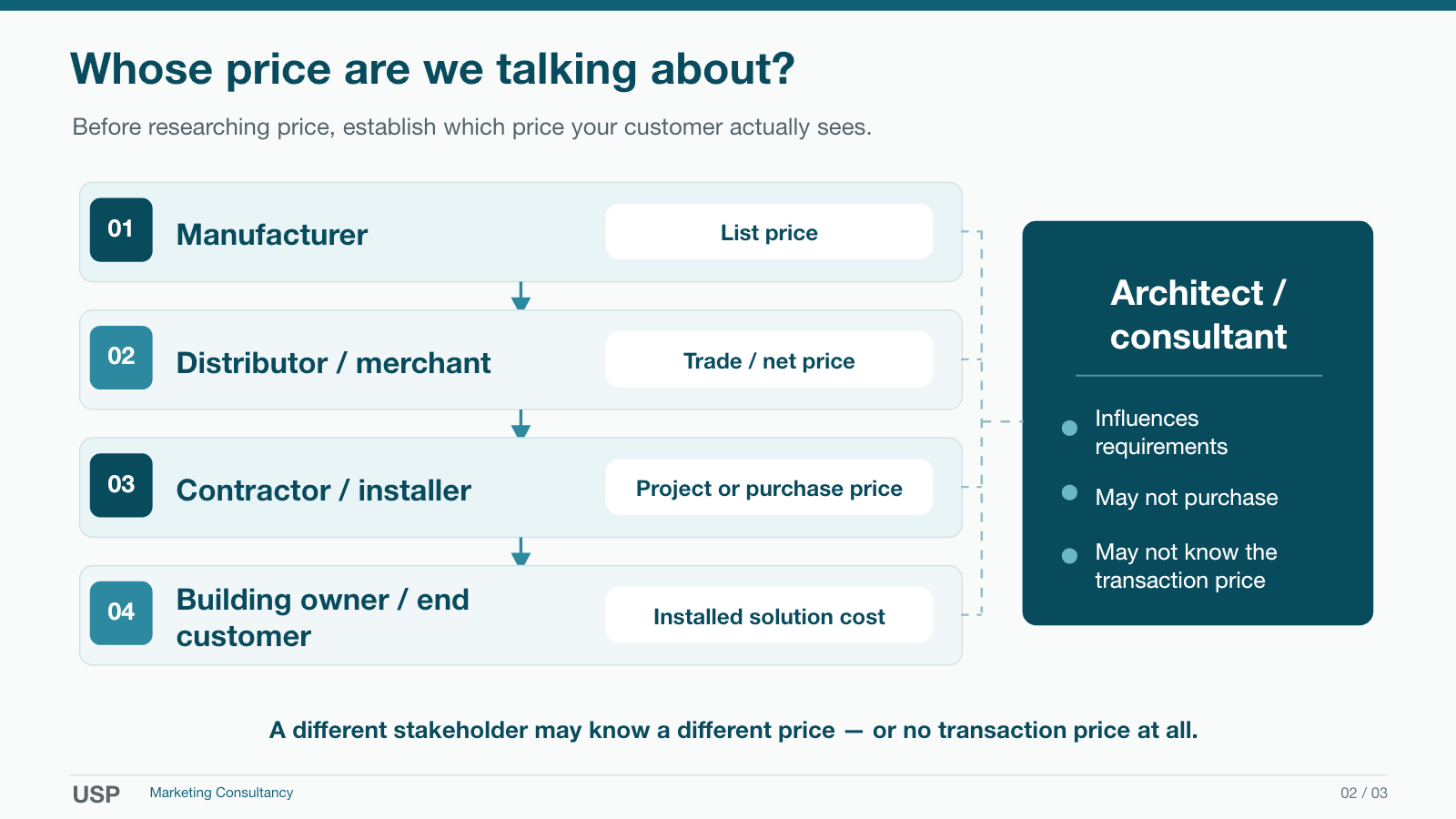
The manufacturer may have a list price. A distributor or merchant has another price. A contractor may receive a negotiated project quotation, while the building owner may only see the cost of the complete installed solution. Ask the wrong person about the wrong price and even sophisticated pricing research can produce a misleading answer.
First decide what you actually need to know about price
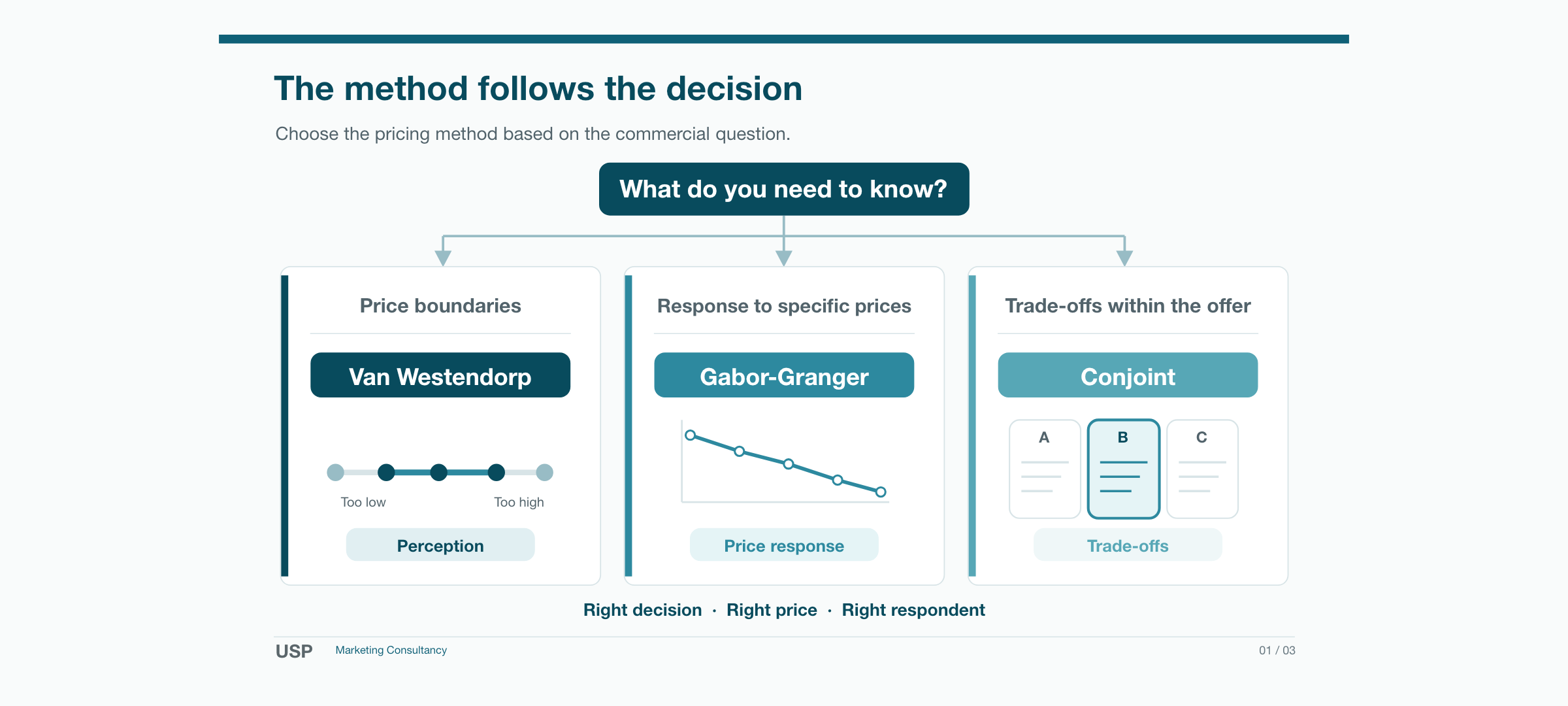
Van Westendorp, Gabor-Granger and conjoint analysis answer different commercial questions. The choice should start with the decision: setting an initial price, changing an existing price, choosing between packages or redesigning the proposition.
| Your pricing question | Method to consider | What it helps you understand |
|---|---|---|
| What price territory does the market perceive as reasonable? | Van Westendorp | Perceived price boundaries |
| How does stated purchase response change at specified prices? | Gabor-Granger | Response to defined price points |
| How do buyers trade price against other elements of an offer? | Choice-based conjoint | Trade-offs between price, performance, brand, service and other attributes |
None of these methods simply produces “the right price”. They provide different pieces of evidence. Before commissioning fieldwork, check what existing customer, transaction and market intelligence already tells you, and identify the uncertainty the new research needs to resolve.
If you are exploring the perceived price territory for a familiar product category, Van Westendorp may be appropriate. If you have a clearly defined product and credible price points to test, Gabor-Granger may be a better fit. If buyers choose between combinations of price, performance, warranty, availability or service, conjoint can investigate those trade-offs together.
Establish which price your customer actually sees
Suppose a building-products manufacturer asks whether €80 would be acceptable. Is that a list or net price, per item or square metre, including or excluding VAT? Does it cover the product alone or the installed solution? Is it a one-off purchase or part of a larger project? Until those questions have been answered, the figure has little commercial meaning.
Before designing pricing research, define:
- The precise product or configuration, market and currency.
- The unit or pack size and VAT basis.
- The relevant channel and price level.
- The buying situation, actual payer and time horizon for the decision.
Respondents need to judge the same price basis. If some are thinking about a merchant net price, others about retail price and others about total installed cost, their answers may describe different decisions.
The person influencing requirements may not pay for the product
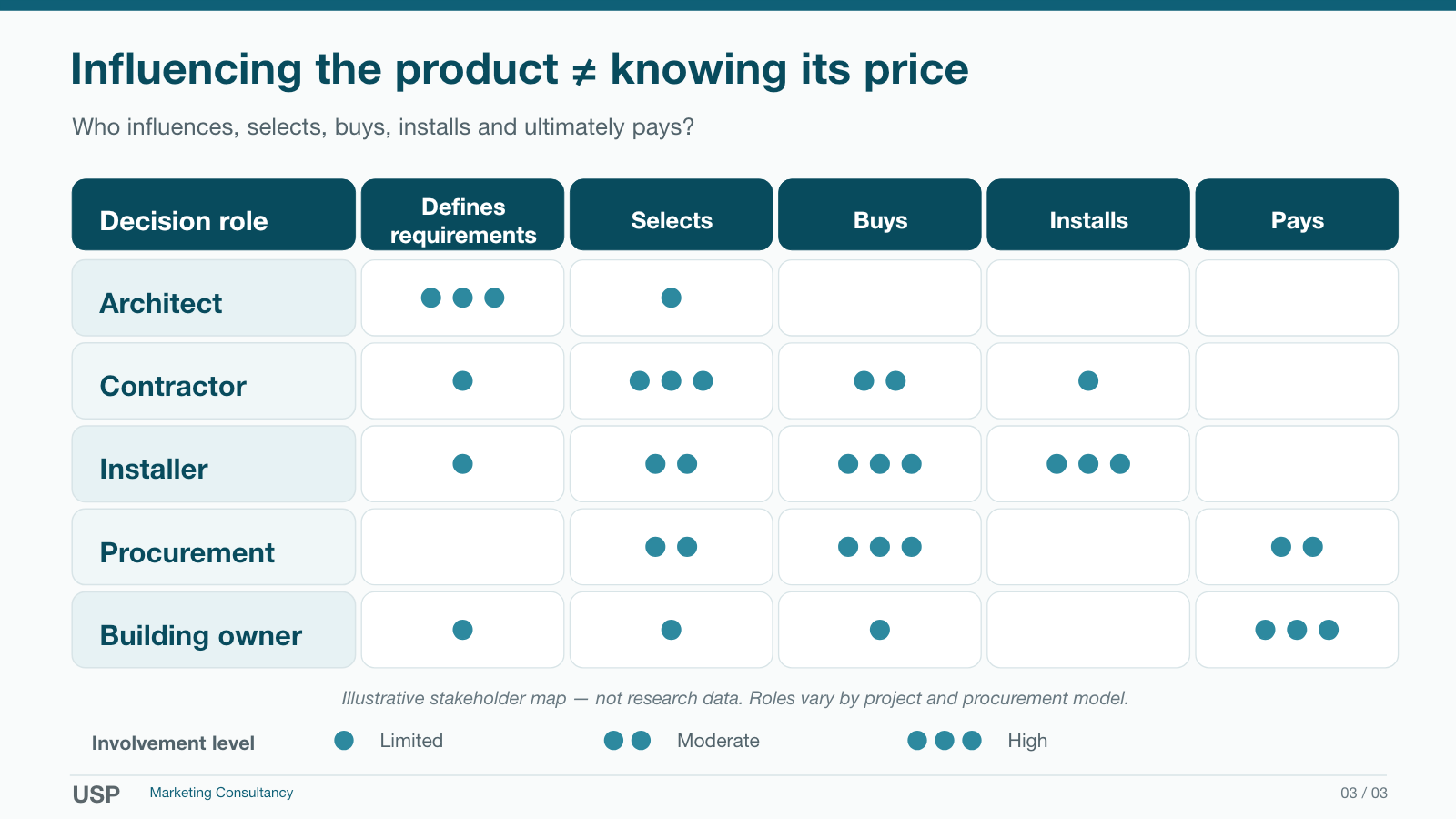
The person defining requirements, the person buying the product, the person installing it and the person ultimately bearing the cost are not necessarily the same.
Consider a hypothetical example. A professional installer regularly buys an established construction product through a building merchant. The installer knows approximately what they normally pay and can meaningfully react to realistic merchant prices.
An architect may influence functional requirements, technical criteria or performance levels. That does not mean the architect buys the product or determines which manufacturer’s product is ultimately purchased. The purchasing decision may sit with a contractor, subcontractor, installer or procurement function.
Both audiences can matter to a manufacturer, but they should not automatically be asked the same pricing question. An installer or purchaser might assess whether they would buy at a specified merchant price. An architect or consultant might explain how cost is balanced against performance, certification and durability when evaluating suitable solutions.
These are different roles, with different knowledge of price and different decisions. A respondent may be well qualified to explain the requirements a solution must meet while having little knowledge of the eventual transaction price. Their input remains useful, but it should inform the question they can answer.
Understand who influences requirements, evaluates eligible solutions, recommends, purchases, installs and pays. The same role mapping also helps define the audiences for product development research.
When should you use Van Westendorp?
The Van Westendorp Price Sensitivity Meter explores perceived price boundaries. Rather than only presenting predetermined prices, it asks respondents to indicate price levels at which the product feels:
- So cheap that quality becomes questionable.
- Inexpensive or a good buy.
- Expensive, but still worth considering.
- Too expensive to consider.
Across respondents, these assessments help investigate the price territory perceived as acceptable. The resulting boundaries and intersections describe price perceptions; they do not establish a commercially optimal price or predict purchases.
This can be valuable when respondents understand the category and have genuine reference points for what products normally cost. Imagine an established trade product that installers purchase regularly in a standard pack size. They understand the category, have purchasing experience and know its normal price.
Now imagine presenting those installers with an unfamiliar technology they have never purchased. When asked at what price it becomes too expensive, what are they comparing it with? The weaker their reference point, the harder it may be to give meaningful monetary answers. Widely varying project conditions can also make responses difficult to compare.
Van Westendorp is most useful when respondents understand both the offer and the pricing context they are being asked to judge.
When should you use Gabor-Granger?
Instead of asking respondents to generate prices themselves, Gabor-Granger presents defined prices and measures stated purchase response. A professional buyer sees a clearly described offer and indicates whether they would be willing or likely to purchase it. Testing carefully selected price levels shows how stated response changes as price changes.
This can be useful when the offer can be defined consistently, realistic candidate prices already exist and respondents understand the buying situation. Keep the product description and price basis constant across price points. The exposure design should account for order, starting-price and anchoring effects, so responses are not interpreted without considering how prices were presented.
You have moved from respondent-generated boundaries to response against researcher-defined prices. But a respondent saying “I would buy this at €75” has not made a purchase. Real decisions also involve competitors, negotiations, supplier relationships, contracts, discounts and availability.
This is particularly relevant in professional building-product markets, where the final transaction price may differ from a manufacturer list price or standard merchant price. A response curve is only interpretable in relation to the offer, audience and buying situation used to produce it.
Multiplying each tested price by its stated purchase response can produce a modelled revenue index for comparison. It is not a forecast of actual revenue, and revenue is not profit. Costs, margins, negotiated discounts, channel economics and commercial strategy still need to inform the pricing decision.
Highly customised offers and negotiated project prices require particular care: respondents must be able to evaluate a credible, consistent buying situation. Gabor-Granger helps answer part of the pricing question; it does not make the commercial decision for you.
When is choice-based conjoint the better fit?
Sometimes researching price in isolation makes little sense. Imagine a contractor or professional purchaser evaluating facade solutions after the project’s technical and functional requirements have been established. Suitable alternatives may differ in price, performance, manufacturer, warranty and lead time.
The question is what the buyer will trade against what. Is additional performance worth a higher price? How valuable is shorter lead time? Does a longer warranty justify a premium? Does the brand influence preference between otherwise suitable alternatives?
In choice-based conjoint, respondents choose between offers in which several attributes vary. The analysis estimates how those attributes contribute to preference under the conditions tested. It can help compare a lower-priced standard proposition with a premium version offering additional performance or service.
Use realistic attributes, levels and competing alternatives, with a no-choice option where appropriate. Mandatory certification or technical requirements establish which solutions are eligible; a lower price should not make an unsuitable product an acceptable alternative. Avoid combinations that could not exist in practice or attributes buyers cannot realistically trade independently.
The no-choice option should reflect the decision being studied. If buyers can postpone the purchase or stay with their existing solution, forcing them to select one of the new offers may hide that possibility. Describe the alternative clearly so respondents understand what declining the presented offers would mean.
A simulated preference share does not automatically become market share after launch. The model reflects the conditions incorporated into the research. It does not automatically account for stronger distribution, purchasing agreements, supplier relationships, competitor reactions, supply constraints or commercial negotiations.
Conjoint helps explain how respondents trade between attributes under the conditions tested. That qualification needs to survive the journey from the research team to the management presentation.
CATI, online or mixed methods?
Choose the research mode according to the audience and task. For representative measurement among professional trades, USP generally favours CATI, computer-assisted telephone interviewing. Verified online approaches can be useful for visual research or studies using verified customer lists.
CATI does not automatically make research representative, and online research is not automatically unrepresentative. What matters is the complete design: the target population, recruitment, respondent eligibility, population coverage, offer presentation and questions.
Check that respondents genuinely encounter or know the relevant price and perform the role the study needs to understand. A sophisticated pricing exercise completed by people who never encounter that price or make the relevant decision remains the wrong research.
Seven questions to answer before commissioning pricing research
Use these questions to make the research brief specific enough to support a commercial decision:
- What commercial decision must the research support? Setting an initial price, changing an existing price, introducing packages or redesigning the proposition?
- What exactly are we pricing? Define the product, configuration and offer.
- Which price actually matters? Manufacturer list price, merchant price, project quotation, unit price, pack price or installed-system price?
- Who actually pays that price? Do not assume the user, recommender or technical stakeholder is also the payer.
- Who influences requirements without paying? Understand the roles of architects, consultants, contractors, installers and other professionals before asking about price.
- Which pricing evidence do we need? Perceived boundaries, response to defined prices, or trade-offs between price and other offer characteristics?
- Which commercial evidence can’t the survey provide? Costs, margins, negotiations, channel economics, distribution constraints, competitor responses and observed purchasing behaviour may need to sit alongside the findings.
Methodological references: Conjointly’s Van Westendorp guide and Sawtooth Software’s explanations of Gabor-Granger, choice-based conjoint and preference-share simulations provide further detail on these methods and their interpretation.
What pricing evidence does your next decision require?
USP Marketing Consultancy has more than 30 years of experience in construction, installation and home improvement. We help manufacturers understand the professional audiences, buying roles and market structures behind pricing decisions.
Discuss your specific pricing or offer decision with USP. Together, we can identify the relevant roles, define the channel price and buying situation, and determine which pricing research approach best fits the decision.

Read more

17 November 2026 I Dirk Hoogenboom
Product development research for building-product manufacturers

20 October 2026
Syndicated vs Custom Market Research: Which Is Right for Construction Manufacturers?

12 October 2026
Ten Questions to Ask Before Hiring a Construction Research Agency

28 September 2026 I Dirk Hoogenboom